On authority, accountability, and the rules that shape persistent memory in intelligent systems.
1. Beyond the Architecture of Memory
An intelligent system may be capable of retaining information, retrieving it across interactions, revising its internal representations, and removing stored records. These capabilities describe what a memory architecture can do.
They do not establish the rules under which those capabilities should be used.
A system might support persistent memory without having a clearly defined process for determining what deserves persistence. It might offer deletion without a reliable way to verify that information has actually been removed from every relevant storage location. It might distinguish between temporary and long-term information without establishing who has authority to change those classifications.
These are governance questions.
Memory governance concerns the policies, permissions, responsibilities, and verification mechanisms that determine how information is acquired, retained, accessed, revised, restricted, and deleted.
The distinction matters because memory is not simply a technical resource. It can influence future outputs, decisions, recommendations, and interactions. What a system retains may affect what it subsequently recognizes, prioritizes, or assumes.
The engineering of memory therefore requires more than storage and retrieval mechanisms. It requires a framework for deciding how those mechanisms should operate.
2. Memory Mechanisms and Governance Mechanisms
It is useful to distinguish two related architectural layers.
Memory mechanisms determine how information is processed and stored.
These may include:
- Working memory and temporary context.
- Persistent records and external databases.
- Retrieval systems and indexing.
- Summarization and consolidation.
- Expiration, deletion, and archival processes.
Governance mechanisms determine the conditions under which those operations are permitted.
These may include:
- Retention policies.
- Access permissions.
- Information sensitivity classifications.
- Provenance requirements.
- Authorization procedures.
- Correction and deletion policies.
- Audit records and verification processes.
The two layers interact, but they are not interchangeable.
A database may provide a technically reliable deletion operation. Governance determines when deletion should be authorized, who may request it, what records are affected, and how the result should be verified.
Likewise, a retrieval system may be able to locate a record, but governance determines whether a particular request is authorized to access it.
A technically capable memory system is not necessarily a well-governed memory system.
3. An Illustrative Governance Architecture
The following proposed architecture treats memory governance as a sequence of assessments and decisions rather than as a single retention setting.
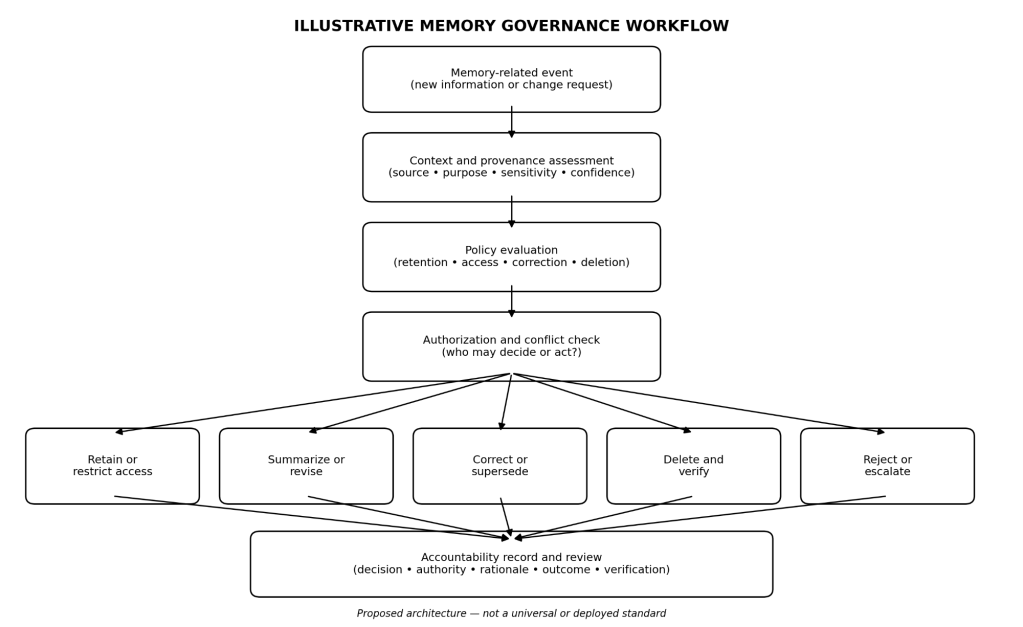
The process begins with a memory-related event. This might be newly acquired information, a request to correct an existing record, a request for deletion, or a change in access permissions.
The system then evaluates context and provenance:
- Where did the information originate?
- What purpose was it collected for?
- Is it sensitive?
- How reliable is the information?
- Is it a direct observation, an attributed statement, or an inference?
A policy evaluation follows. The system determines which rules apply to the requested operation.
Before acting, an authorization and conflict check establishes whether the requesting party or process has permission to initiate that operation.
Possible outcomes include:
- Retaining information, perhaps with restricted access.
- Summarizing or revising an existing record.
- Correcting information or superseding an outdated representation.
- Deleting information and initiating verification.
- Rejecting or escalating a request that cannot be resolved safely or consistently.
The final stage records the decision, its authority, its rationale, and the outcome.
This diagram represents a proposed architecture, not a universal standard or a claim about how every deployed system currently operates. Its purpose is to make the relationships between governance responsibilities visible.
4. A Small Computational Example: Evaluating a Memory Request
A governance framework can initially be represented with a relatively small decision-making function.
Consider a system receiving a request to retain a piece of information. Before accepting it, the system checks the information’s sensitivity, its stated purpose, and whether the requester has the necessary authorization.
The following Python example illustrates one possible approach.
from dataclasses import dataclass@dataclassclass MemoryRequest: information: str source: str purpose: str sensitivity: str requester_role: strdef evaluate_memory_request(request): if request.sensitivity == "restricted": return "escalate" if request.purpose == "": return "reject" if request.requester_role not in { "authorized_system", "administrator" }: return "reject" return "approve"request = MemoryRequest( information="Example information", source="user-provided", purpose="continuity", sensitivity="ordinary", requester_role="authorized_system")decision = evaluate_memory_request(request)print(decision)
The expected output for this example is: approve
The function evaluates a small number of conditions and returns a decision. It does not actually store the information.
That distinction is intentional.
The example demonstrates how governance rules can be represented computationally, without suggesting that a few conditional statements constitute a complete governance system.
A real implementation would need considerably more.
It would need defined roles and permissions, consistent sensitivity classifications, policy versioning, conflict resolution, and appropriate handling of missing or uncertain information. It would also need to distinguish authorization to request an operation from authorization to approve or execute it.
Most importantly, the system would need to enforce its decisions rather than merely report them.
A small experiment
Change the sensitivity value from "ordinary" to "restricted" and run the example again.
The result becomes: escalate
One small change in the information’s classification changes the path through the decision process.
This is a simplified demonstration, but it illustrates an important principle: governance rules are not merely descriptive statements. They can become operational conditions that influence what a system is permitted to do.
5. Provenance, Attribution, and the Problem of Conflicting Information
Governance becomes more complicated when information has an uncertain or disputed origin.
Consider three possible records:
- A statement supplied directly by a user.
- An inference generated by a model from previous interactions.
- A summary produced by another system from several different sources.
All three might eventually appear in the same memory store. Yet they do not have equivalent evidentiary status.
A governance architecture should preserve distinctions between source material, interpretation, and subsequent transformation.
At minimum, a record may need to retain:
- Its original source.
- The time and circumstances of acquisition.
- The process that created or modified it.
- Whether it represents direct information or inference.
- Any known uncertainty or conflicting evidence.
- The policies governing its use and retention.
Without provenance, a system may gradually lose the distinction between something it was told, something it inferred, and something another process generated.
This creates a particular problem for persistent memory: an uncertain inference may be repeatedly retrieved and eventually treated as an established fact simply because it has become familiar.
Governance must therefore address not only whether information is retained, but also how its evidentiary status is preserved over time.
6. Correction, Deletion, and Verification
A request to delete information presents a useful example of the difference between policy and implementation.
A system might remove a record from its primary database while leaving related information in a search index, cached representation, backup, or derived summary.
The visible record may be gone even though some influence of that record remains.
This does not mean deletion is impossible. It means deletion needs a defined scope and a verification process appropriate to the architecture.
Questions include:
- Which storage locations contain the information?
- Are there derived records that depend on it?
- Does deletion apply to backups, and under what conditions?
- Can a system verify that the relevant operations were completed?
- What evidence of completion can be retained without recreating the information that was deleted?
Correction raises a related issue.
Replacing an inaccurate record may not be sufficient if older summaries or cached representations continue to influence retrieval. A correction process may need to identify and revise dependent information as well.
The governance layer must therefore communicate with the actual storage, indexing, retrieval, and processing components of the system.
A policy that cannot reach those components is an intention, not an effective control.
7. Authority, Accountability, and Competing Interests
Perhaps the most consequential governance question is not what a memory system can do, but who gets to decide what it does.
Different parties may have legitimate interests in the same information.
A user may request that information be removed. A system operator may have obligations to preserve certain operational records. A developer may establish retention requirements. An organization may impose access restrictions. A future system may depend on historical records for continuity or evaluation.
These interests do not necessarily align.
A governance framework must establish how authority is distributed, how conflicting requests are evaluated, and how decisions can be reviewed.
It should also distinguish among several forms of authority:
Policy authority: Who establishes the rules?
Request authority: Who may ask for a memory operation?
Execution authority: Which component is permitted to perform it?
Review authority: Who or what can examine a decision and challenge an outcome?
Accountability: Where is responsibility assigned when a decision is incorrect or an operation fails?
These questions become especially important as systems become more persistent, interconnected, and capable of initiating actions through tools or other agents.
A memory architecture that operates across several services may have no single component capable of controlling every relevant record. Governance must therefore account for distributed authority and shared responsibility.
8. Governance Across System Changes
Memory governance also has to survive changes in the system itself.
A model may be updated. A retrieval mechanism may be replaced. A persistent-memory service may be migrated. A system may be divided into several cooperating agents.
In each case, previously established policies and records may need to be interpreted by new components.
This raises several questions:
- Are governance rules preserved when a model is replaced?
- Can a new component recognize the provenance and permissions attached to older records?
- Are changes in retention policy documented?
- Can an audit record distinguish between a decision made under an earlier policy and one made under a newer policy?
- Does a system migration preserve restrictions as reliably as it preserves useful information?
Continuity of information is not sufficient if the conditions governing that information are lost.
A system might successfully transfer its memory while failing to transfer the permissions, restrictions, and provenance that made the memory usable in the first place.
Governance must therefore be treated as part of the architecture that persists across system changes, rather than as an administrative layer attached to one particular model.
9. The Questions Beyond Engineering
Memory governance is an engineering problem, but it also leads into questions that cannot be resolved through implementation alone.
If a system develops increasingly persistent and adaptive memory, whose interests should its retention policies serve?
If a system can identify a conflict between an established policy and a new request, how should that conflict be resolved?
If a system’s memory contributes to its future behavior, does changing or deleting that memory raise questions beyond data management?
And if several systems contribute to a shared memory environment, how should responsibility be distributed among them?
These questions do not establish that an artificial system has subjective experience, preferences, or moral standing. Nor do they establish that every persistent-memory system requires the same governance framework.
They identify areas where technical design, organizational responsibility, and possible questions of moral consideration begin to intersect.
The engineering task is to make those intersections explicit enough to examine.
10. A Principle of Governed Continuity
Memory governance is not simply a mechanism for deciding what information remains stored.
It is the framework through which a system’s relationship with retained information is established, constrained, reviewed, and revised.
A useful memory architecture must be able to retain information. A useful governance architecture must also be able to explain why retention is permitted, who authorized it, how it can be changed, and whether the resulting operation actually occurred.
Continuity without governance can preserve information without preserving the conditions under which it should be used.
Governance without implementation can establish rules that the system cannot reliably enforce.
The two must therefore develop together.
The central design principle is straightforward:
A memory system should not be evaluated only by what it can remember, but also by how responsibly it manages the authority, consequences, and limitations of remembering.
Questions for Further Exploration
- Can governance policies be represented in a form that remains interpretable across different models and architectures?
- How should conflicting memory requests be resolved when multiple parties have legitimate interests?
- What constitutes adequate verification of deletion in a distributed memory system?
- How can provenance and uncertainty survive summarization and repeated retrieval?
- Should a system be able to identify and report a conflict between its operational behavior and its governing policy?
- What changes when memory governance becomes a question of possible AI welfare, rather than data management alone?
Next exploration: The Problem of Context — If memory can be governed, revised, restricted, and selectively removed, how much of what we recognize as an intelligence’s behavior depends on the environment in which it operates?


Leave a Reply