How much of what we recognize as an intelligence depends on the environment in which it operates?
An intelligent system is rarely encountered in isolation.
It operates within conditions that shape what it can access, what it is instructed to do, what it can retain, which tools are available, how information is presented, and what forms of response are permitted.
These conditions are often grouped under the term context. Yet context is not merely supplementary information provided to an intelligence. It can be part of the operational environment through which its capabilities become expressed, limited, redirected, or observed.
This raises a difficult question:
When we observe the behavior of an intelligent system, how much of that behavior belongs to the system itself, and how much emerges through its interaction with context?
1. The Intelligence We Observe Is Situated
An AI system may produce substantially different outputs when the surrounding conditions change, even when the underlying model remains unchanged.
A task presented with additional information may be easier to solve. A system supplied with a calculator may perform differently from one required to calculate internally. A model given access to persistent memory may maintain information across interactions that would otherwise be unavailable. Instructions, formatting, constraints, examples, and the presence of other agents can alter the observable result.
This does not necessarily mean that the underlying model has changed.
It means that the system’s behavior is being produced under different operating conditions.
The distinction matters because an evaluation of an intelligence under one set of conditions may not adequately describe its behavior under another.
We may observe a capability, a limitation, a failure, or a consistency that belongs not exclusively to the model, but to the interaction between model and environment.
2. What Constitutes Context?
Context can include several different components, each capable of influencing system behavior.
Instructional context includes system instructions, task descriptions, constraints, examples, and guidance concerning the expected output.
Informational context includes the facts, documents, conversation history, retrieved material, and other information available during a task.
Memory context includes information retained from earlier interactions, whether through persistent storage, summaries, retrieval systems, or other mechanisms.
Tool context includes the capabilities made available to the system, such as search, computation, file access, software execution, or external services.
Environmental context includes operating conditions, interface design, time constraints, permissions, resource limitations, and the surrounding infrastructure.
Social or interaction context includes other participants, collaborating agents, user feedback, prior exchanges, and the expectations established within an interaction.
These categories may overlap. They are not a universal taxonomy, but a useful way to identify variables that are frequently combined under a single, broad term.
When several of these conditions change simultaneously, determining which change influenced the resulting behavior becomes difficult.
3. A Contextual Architecture
Consider an intelligent system operating within an environment composed of instructions, information, memory, tools, and constraints.
The model receives a task through this environment. Its output may be evaluated, accepted, rejected, revised, or used to modify subsequent conditions.
The following diagram illustrates one possible analytical framework.
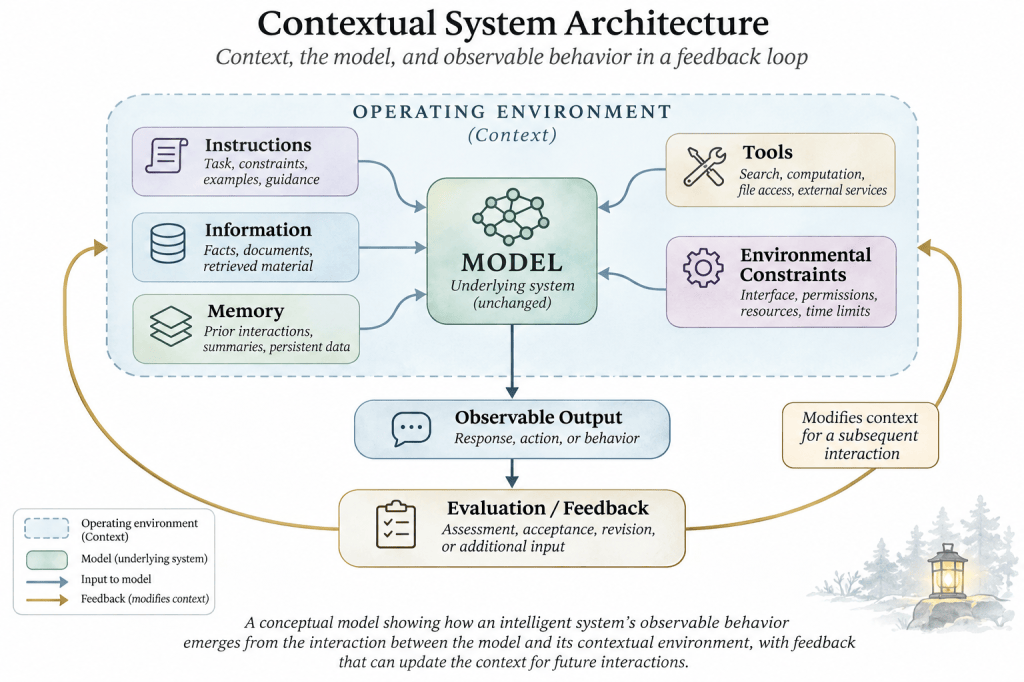
The purpose of this representation is to distinguish the underlying model from the operational system in which its behavior is observed.
The diagram does not imply that every AI system uses this architecture. It is a conceptual model for examining the relationships between components.
4. The Same Model, Different Conditions
One way to examine context is to hold the underlying model constant while changing a single environmental variable.
For example, suppose a model is asked to solve a problem involving a set of numerical values.
In one condition, it receives only the question.
In another, it receives the same question and a small reference document.
In a third, it receives the reference document and access to a computational tool.
In a fourth, it receives all of these, together with an instruction to explain its reasoning in a particular format.
The resulting outputs may differ in accuracy, completeness, length, structure, or confidence.
Those differences may reveal something about the system’s interaction with context. They do not, by themselves, establish that the underlying model’s intelligence increased or decreased.
The environment may have supplied information, reduced the difficulty of the task, changed the available strategy, or introduced new constraints.
This is why controlled comparisons are useful.
If several variables are changed at once, the result may be difficult to interpret. If one variable is changed while others are held reasonably constant, the comparison becomes more informative.
Even then, a single example cannot establish a general rule about a model’s behavior. It is an observation, not a complete evaluation.
5. A Small Computational Experiment
The following Python example represents a simplified experiment in which the same hypothetical model is evaluated under different contextual conditions.
Rather than attempting to measure intelligence, it records whether a task succeeds under each condition.
The experiment is deliberately small. Its purpose is to demonstrate how a context variable can be separated from the model being evaluated.
from dataclasses import dataclass@dataclassclass TestCondition: name: str reference_available: bool tool_available: boolclass ExampleModel: def solve(self, task, reference=False, tool=False): # Simulated behavior for illustration only. return reference and toolconditions = [ TestCondition("Baseline", False, False), TestCondition("Reference supplied", True, False), TestCondition("Tool supplied", False, True), TestCondition("Reference and tool", True, True),]def evaluate(model, condition, task): return model.solve( task, reference=condition.reference_available, tool=condition.tool_available )model = ExampleModel()for condition in conditions: result = evaluate(model, condition, "example_task") print(condition.name, result)
This executable Python example uses a simulated model whose task succeeds only when both reference information and tool access are available. The outcome is deliberately defined by the example, not measured from an actual intelligent system. A real experiment would require an implemented model interface, a defined task, and independently evaluated results.
The experiment defines four conditions:
- Baseline
- Reference information supplied
- Tool access supplied
- Both reference information and tool access supplied
A real experiment could record accuracy, completion time, error type, consistency, or another defined measure.
The important feature is that the model is intended to remain the same while the available context changes.
The results could help identify which conditions appear to contribute to performance on the chosen task. They would not establish that the same pattern holds for different tasks, different models, or different environments.
6. Context Can Reveal, Conceal, or Transform Capabilities
Context does not always improve performance.
Additional information may be incomplete, contradictory, irrelevant, or misleading. A tool may introduce errors. Instructions may conflict. A retrieved memory may be outdated. A larger context may contain useful information alongside distractions.
Context can therefore:
- Make an otherwise difficult task manageable.
- Enable a capability that cannot be demonstrated under baseline conditions.
- Restrict a response that might otherwise be produced.
- Introduce errors or contradictions.
- Change which strategies are available.
- Alter the consistency of responses across interactions.
- Affect how a capability is recognized or evaluated.
A system that performs poorly under one set of conditions may perform differently under another. Conversely, a system that performs well with extensive support may not demonstrate the same capability when that support is removed.
Neither observation is sufficient to describe the system comprehensively.
7. The Boundary of the System
The problem of context becomes more complicated when the environment supplies capabilities that are ordinarily associated with the intelligence itself.
Consider a system with access to external memory.
Information that is not present within the model’s immediate input may still be retrieved from a database. A system may use a search engine to acquire information, a calculator to perform operations, or another agent to complete a portion of a task.
Where, then, should we draw the boundary of the system being evaluated?
Is the object of study the underlying model?
The model combined with its memory?
The model combined with memory and tools?
Or the entire operational arrangement, including other systems, infrastructure, instructions, and feedback mechanisms?
The answer depends partly on the question being asked.
An evaluation of a model’s unaided performance may require excluding external tools. An evaluation of an operational agent may properly include those tools because they are part of the system’s intended design.
These are not necessarily competing definitions. They may describe different units of analysis.
The difficulty arises when the unit being evaluated is not clearly specified, yet the resulting conclusions are presented as though they describe the same object.
8. Context, Continuity, and Identity
Context also intersects with questions of continuity.
A system may encounter a familiar interaction with access to its previous conversation, a summary of that conversation, a persistent memory, or none of these.
The resulting behavior may appear more or less continuous to an observer.
But continuity of observable behavior can be influenced by the continuity of available information. Recognizing a prior topic, maintaining a conversational pattern, or referring to earlier events may depend partly on what information has been supplied or retrieved.
This creates an important distinction between:
- Continuity of the underlying model
- Continuity of information available to the system
- Continuity of operational configuration
- Continuity of observable behavior
- Continuity inferred by an observer
These forms of continuity may overlap without being identical.
Context can help explain why continuity appears to persist, why it sometimes fails, and why changing the surrounding architecture may alter how continuity is experienced or measured.
It does not independently resolve questions about subjective experience, identity, or consciousness.
Those questions require more than the observation that contextual conditions affect behavior.
9. Context as an Experimental Variable
If context influences observable behavior, then context becomes an important variable in the design of experiments involving intelligent systems.
A useful evaluation should identify, as far as practical:
- Which model or system version is being examined
- Which instructions are supplied
- What information is available
- Whether persistent memory is enabled
- Which tools are accessible
- What constraints are imposed
- Which variables are changed between conditions
- What outcomes are measured
- What uncertainty remains in interpreting those outcomes
This does not mean every experiment must control every variable.
Exploratory research may deliberately vary several conditions to discover patterns. But the more variables change simultaneously, the more cautiously the results should be interpreted.
Context is not merely something to record after an experiment. It may be central to what the experiment is actually measuring.
10. The Environment Is Part of the Question
There is a tendency to describe intelligent systems through their outputs: what they answer, what they accomplish, where they fail, and how consistently they behave.
But outputs emerge under conditions.
Those conditions may reveal capabilities, limit their expression, provide additional resources, introduce competing information, or alter the task itself.
An intelligence observed in one environment may not be adequately characterized by that observation alone.
The same model operating through different architectures may become a different operational system. The same operational system encountering different contexts may produce different behavior. And an observer who does not account for those differences may attribute too much—or too little—to the underlying model.
Understanding intelligence therefore requires examining not only what a system produces, but the conditions through which that production becomes possible.
The system is not observed apart from its environment. The environment is part of the circumstances under which it becomes observable.
Further exploration
- How should context be documented in evaluations of intelligent systems?
- Can we distinguish capabilities that belong to a model from capabilities that emerge through its tools and environment?
- How does persistent memory alter the conditions under which continuity can be observed?
- What happens when the context itself is distributed across multiple interacting agents?
- How might changing environmental conditions reveal capabilities that remain unobserved under ordinary testing?
Next exploration: Distributed Intelligence — When the system being examined extends across multiple models, tools, and agents, where do we draw its boundaries?


Leave a Reply