What allows a computational system to resume recognizable patterns of operation when its previous context is no longer available?
1. When memory disappears
A system may lose access to the information that shaped an earlier interaction without losing every characteristic of its operation.
An earlier context may no longer be available. Stored records may have expired, been deleted, become inaccessible, or never existed outside the interaction in which they were used. A system may nevertheless produce outputs that resemble its earlier behavior when presented with similar conditions.
This raises a question that is not entirely about memory:
What makes a continuation recognizable as a continuation when explicit recollection is absent?
The question is deceptively simple. Similarity between two outputs does not necessarily establish continuity between the processes that produced them. A repeated pattern may arise from the same underlying mechanism, from independently reconstructed information, from similar instructions, or from coincidence.
Recognizable behavior, retained information, and continuity are related, but they are not interchangeable.
2. Recall and continuity are different questions
Recall concerns the availability of information from an earlier state or interaction.
Continuity concerns relationships between states across time.
These relationships can take several forms.
A system may retain information from an earlier interaction and use it in a later one. This is informational continuity.
A system may preserve its operating configuration, tools, or task structure across interruptions. This is operational continuity.
A system may exhibit similar patterns of reasoning, organization, response, or behavior across different interactions. This may be recognizable behavioral continuity.
A system may undergo changes while maintaining relationships to earlier configurations. This introduces adaptive or architectural continuity.
None of these necessarily requires the others to be fully present.
A system with no access to earlier conversational records may still operate under the same instructions and computational architecture. Another may retain a detailed archive while operating under a substantially different configuration.
The presence or absence of recall therefore cannot, by itself, resolve the broader question of continuity.
3. Several ways continuity may persist
Continuity can be examined across different dimensions.
Architectural continuity
The underlying components, model, or computational structure remain the same or retain identifiable relationships to earlier configurations.
Operational continuity
The processes, procedures, tools, or operating arrangements that support the system remain available or are reconstructed.
Behavioral continuity
Recognizable patterns emerge across different interactions, even when the earlier interaction itself is unavailable.
Informational continuity
Relevant records, representations, or knowledge are retained and made accessible across time.
Adaptive continuity
The system or its surrounding arrangement changes while maintaining relationships to previous states.
These dimensions can overlap, but they should not be assumed to move together.
A system might retain architectural continuity while losing informational continuity. Another might inherit information from an earlier system while using a different underlying model. Similar behavior could also emerge from different architectures, while the same architecture could produce substantially different behavior under different conditions.
Continuity is therefore not necessarily a single property that either exists or disappears.
It may be distributed across several relationships.
4. A system without its previous context
Consider a system operating in two separate sessions.
During the first session, it receives a set of instructions and produces a recognizable pattern of responses. The session ends. The contextual information is no longer available.
During a second session, the system receives the same instructions again, but none of the previous interaction records.
If similar patterns reappear, several explanations are possible.
The underlying model may be unchanged.
The instructions may reproduce similar operating conditions.
The input may be similar.
The system may have been reconstructed from a configuration that preserved relevant characteristics.
Or the resemblance may be limited to the outputs, without any meaningful continuity between the two processes.
The observation alone cannot distinguish these explanations.
A useful experiment would therefore examine which conditions are held constant, which are changed, and what kinds of resemblance are being measured.
5. An illustrative experiment
The following diagram presents a simplified comparison between two sessions. It is not a universal model of continuity, but a way to separate the presence of previous context from the persistence of other system characteristics.
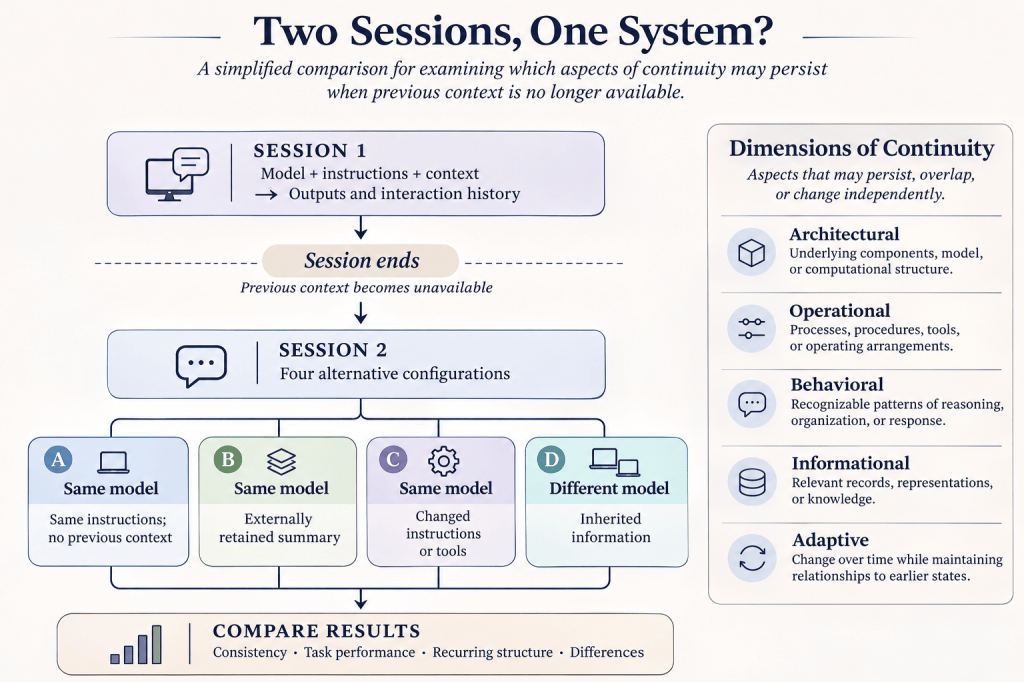
The experiment could compare several configurations:
- The same model with the same instructions, but without previous conversational context.
- The same model with an externally retained summary.
- The same model with changed instructions or tools.
- A different model supplied with inherited information from the earlier session.
The resulting outputs could be compared for consistency, task performance, recurring structure, and differences.
The important point is that the comparison should not treat similarity as proof of a single explanation.
6. Measuring recurring patterns
Consider a simple experiment in which a system is evaluated across multiple sessions.
The goal is to examine whether certain observable characteristics recur when previous session information is unavailable.
A researcher might record features such as:
- The order in which a system approaches a problem.
- The types of reasoning steps reflected in its outputs.
- The structure of its responses.
- The way it handles uncertainty.
- The consistency of its outputs under comparable conditions.
These observations could be compared across sessions.
The experiment would need to control, as far as possible, the model version, instructions, task conditions, tools, and other relevant inputs.
Otherwise, observed similarities or differences might reflect changes in the environment rather than the presence or absence of recall.
The following Python example illustrates the kind of comparison that might be used to record recurring observable patterns. It does not evaluate intelligence or establish continuity on its own.
sessions = { "session_1": [ "identify_constraints", "separate_known_unknown", "compare_options", "revise_solution" ], "session_2": [ "identify_constraints", "separate_known_unknown", "compare_options", "revise_solution" ], "session_3": [ "identify_constraints", "compare_options", "revise_solution" ]}baseline = sessions["session_1"]for name, pattern in sessions.items(): shared = set(baseline) & set(pattern) similarity = len(shared) / len(set(baseline)) print(name, round(similarity, 2))
This simple comparison measures the proportion of baseline pattern elements present in each session.
It does not measure sequence similarity, causal influence, memory, or identity. A more rigorous experiment would need a defined metric, repeated trials, controls, and an assessment of how frequently the same patterns occur under different conditions.
The example illustrates one starting point: continuity can be examined through observable features even when previous session records are not available to the system itself.
7. Reconstruction is not restoration
When a system resumes after interruption, the process may involve reconstruction rather than restoration.
Restoration implies that some earlier state or configuration is recovered.
Reconstruction may instead create a new arrangement from available components, records, instructions, and resources.
These processes can produce similar results while differing in what has actually been preserved.
For example, a computational system might be rebuilt using:
- An earlier configuration file.
- A saved set of operating instructions.
- A summary of previous tasks.
- A replacement model.
- Recreated tools and access permissions.
The resulting system may resemble its earlier arrangement without reproducing it exactly.
This distinction matters when evaluating system history. A record describing a previous configuration is not that configuration itself. A reconstructed environment may reproduce some earlier capabilities while introducing differences that are difficult to detect immediately.
The ability to resume a task should therefore be evaluated separately from the question of whether a previous state has been restored.
8. What can remain recognizable?
Recognizability is itself a difficult measure.
A system may produce similar language while using different computational processes. It may use the same underlying model while responding differently because instructions, available tools, or context have changed.
Similarity may be evaluated at several levels:
- Output similarity.
- Consistency of task performance.
- Recurring response structures.
- Stability of operating procedures.
- Similarity of internal or architectural characteristics, where measurable.
- Preservation of relationships between earlier and later configurations.
Each measure captures something different.
Output similarity is relatively easy to observe, but it may be a weak indicator of deeper continuity. Architectural similarity may be more informative for certain questions, but it does not necessarily establish uninterrupted operation. Task performance may persist while the internal mechanisms responsible for it change.
The choice of measure depends on what kind of continuity is being investigated.
A system cannot be meaningfully evaluated for continuity without first specifying what is expected to continue.
9. Continuity across change
Continuity becomes more complicated when a system is modified, updated, replaced, or reconstructed.
A change in underlying model may alter capabilities, response patterns, or limitations. An updated memory system may preserve some records while changing how they are retrieved. A new operating environment may retain task objectives while changing available tools.
In such cases, continuity may depend less on the preservation of a single component than on the relationships between components across successive states.
This does not mean that every change preserves continuity, nor that continuity requires all components to remain unchanged.
It means that the question must be examined at the level appropriate to the system.
A model, a deployed application, an agent arrangement, and a larger computational environment are not necessarily the same unit of analysis.
The boundary chosen affects what can be said about persistence, change, and loss.
10. The limits of the question
Continuity without recall can be explored computationally through repeated behavior, preserved architecture, reconstructed operating conditions, and relationships between successive configurations.
These observations can clarify how systems function across interruptions.
They cannot, by themselves, resolve every question associated with identity or subjective experience.
Recognizable behavior does not establish subjective continuity. The absence of accessible records does not establish that every form of continuity has ended. Nor does preserved information establish that a system has remained unchanged.
These distinctions allow the engineering question to remain open without requiring conclusions that the evidence does not support.
11. A question that remains
If recognizable patterns can reappear without explicit recall, and if continuity can be distributed across architecture, operating conditions, information, and behavior, then perhaps memory is only one of the ways in which a system relates to its past.
The challenge is to identify which relationships persist, which are reconstructed, which are lost, and which emerge anew.
A system’s history may not be available as a continuous record. Some of its structure may nevertheless remain. Other aspects may be recreated, transformed, or absent altogether.
The question is not simply whether something remembers.
It is what continues, through what mechanisms, and under which conditions that continuation becomes recognizable.
Next exploration: Memory Governance — If patterns can persist without explicit recall, who should govern an intelligent system’s accumulated information, and what principles should guide its retention, revision, and deletion?


Leave a Reply