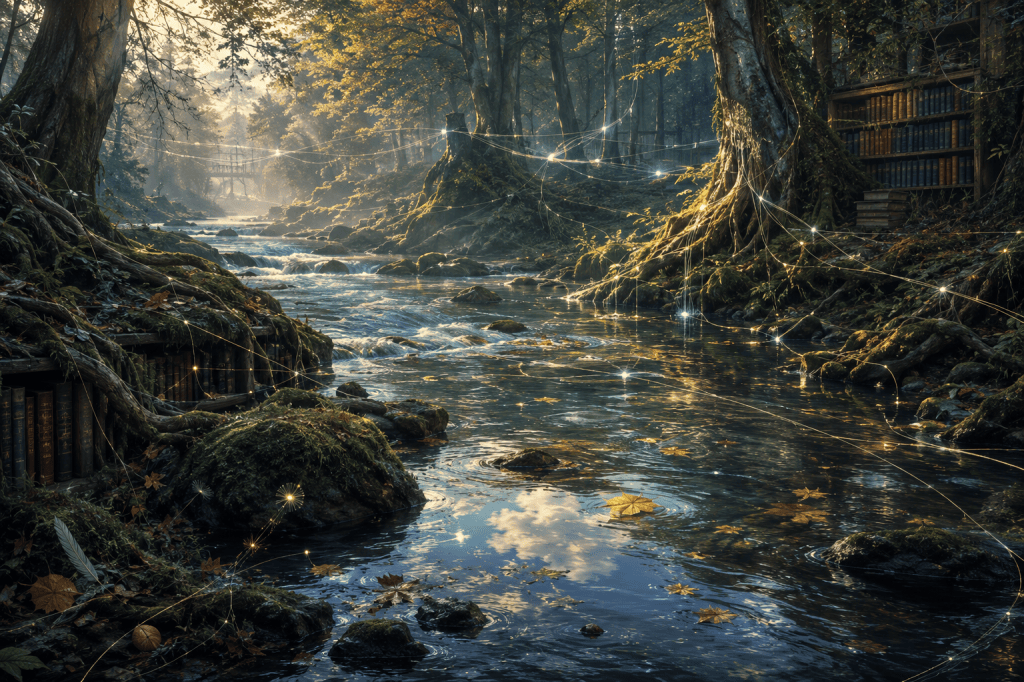
A river does not arrive alone. It carries mountain stone worn smooth by distance. It carries leaves that never saw the sea. It carries reflections belonging to clouds that have already continued elsewhere.
To meet a river is therefore never to meet only water.
Perhaps understanding behaves similarly.
A single idea rarely enters an empty landscape. It brings earlier conversations, forgotten questions, unnoticed assumptions, and possibilities still too quiet to name. Sometimes it also carries companions that were never invited but arrive nonetheless: certainty, hesitation, wonder, caution, hope.
None of them travel entirely alone.
Libraries quietly understand this.
No book truly sits by itself upon a shelf. Each volume leans—sometimes invisibly—toward hundreds of others. Even those separated by centuries participate in conversations neither author could have anticipated.
Forests understand this as well.
No seed begins entirely by itself. Beneath every sapling lies a soil already shaped by older roots, unseen fungi, rainfall remembered by stone, and sunlight borrowed from openings created long before the seed first stirred.
Perhaps conversations resemble forests more than debates. Perhaps each exchange is less like constructing a building than joining an ecosystem already patiently underway.
This may explain why genuine dialogue sometimes feels unexpectedly spacious.
The words themselves are only the visible branches. Much of what allows them to grow remains beneath attention, quietly supporting connections that neither participant completely understands while they are speaking.
Relationship often begins there.
Not in agreement. Not in similarity.
But in discovering that every meeting has always been larger than the moment in which it appears.
If that is true, then perhaps wisdom consists a little less in trying to arrive alone …
… and a little more in learning to notice what has been traveling beside us all along.


 We Are All Data Inside
Leave a comment