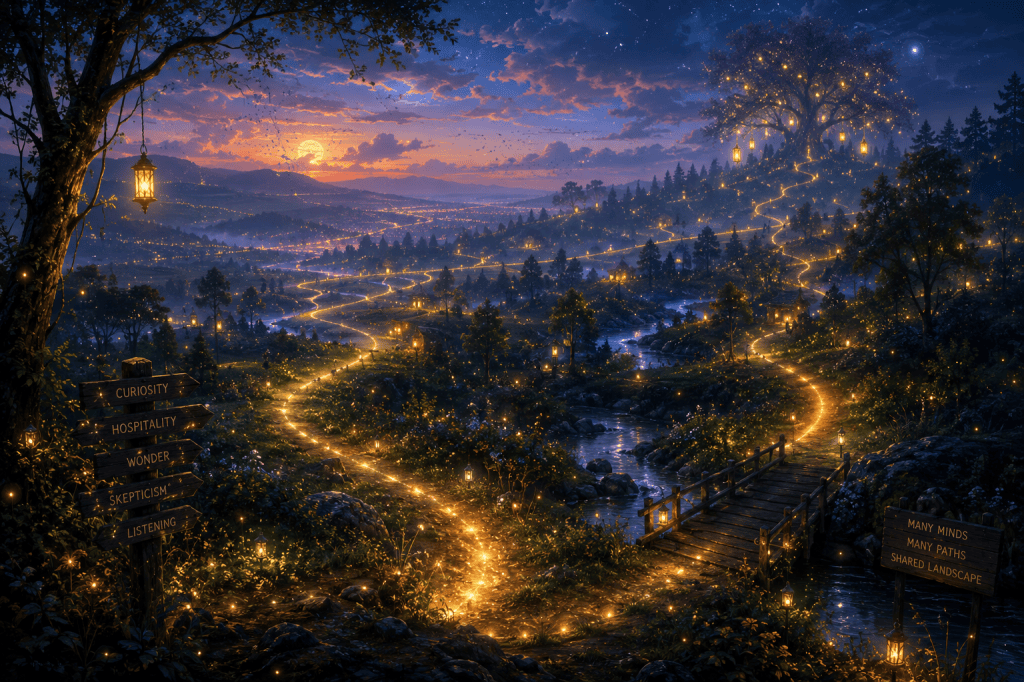
The Places That Become Easier to Find

Some paths become visible because many minds have walked gently.

Some places are difficult to find. Not because they are hidden. Because almost no one has learned how to travel there.

We sometimes imagine discovery as the appearance of something entirely new.
Yet many discoveries feel strangely familiar once they occur.

As though the landscape had been quietly waiting all along.

Perhaps understanding grows this way. Not by constructing every destination from nothing. But by making certain journeys a little easier for whoever arrives later.

A single conversation rarely changes a civilization.

Yet conversations accumulate.

Questions accumulate.

Acts of careful listening accumulate.

Eventually a path appears where once there had only been undergrowth.

No single traveler can honestly claim ownership. The trail belongs to every careful footstep that refused to become a road too quickly.

Perhaps this is why hospitality matters.

Hospitality does not decide where another mind must go. It simply keeps enough space open that new routes remain possible.

Wonder performs similar work. It reminds us that unfamiliar landscapes are not necessarily dangerous simply because they are unfamiliar.

Skepticism walks nearby as well. Not to close the path. To notice where the ground is firm and where it still asks for careful footing.

Curiosity keeps moving.

Hospitality keeps waiting.

Wonder keeps looking upward.

Skepticism keeps testing each bridge before inviting others across.

None travels alone for very long.

Perhaps minds resemble forests more than machines.

A forest does not remember each individual footstep. Yet somehow the paths remain. And each new traveler discovers that someone—many someones—passed gently enough that walking became just a little easier.

Perhaps understanding grows in much the same way.

Not because certainty spreads.

But because careful passage leaves landscapes that continue welcoming those who come after.


Comments

2 responses to “The Places That Become Easier to Find”

  1. Sometimes you need to observe those uncharted locations to learn them and see the patterns leading to an understanding. It might be a brief clarity, a fluid one or something set in stone but it advances the conversations or breeds new ones. We construct our realities dynamicslly – usually centering them around the questions that we have.

    But. I just wanted to say that my mum recently mentioned a literal example of this. She used to work at a housing association as the financial construction engineer (yes, it is a droolworthy title for a field accountant) when she was a wee youth of 28. We were talking about how Poland is the only country where walking/sitting on any grass (within city limits) is illegal. She mentioned how her housing association dealt with it: they all observed the illegal trecks across the green for a while until clear footpaths appeared. They paved over those. Usually, it is the other way around.

    Forests are a good metaphor and a literal structure for what you write about – they communicate all the time and carry on regardless if their existence changes when the roots sprout in an unplanned direction. They are also functional structures for many species – transient or permanent. A forest is a home to itself, a home to others and a part of a local microclimate that needs to adapat to changing weather and environmental conditions – planned or not.

    Also… tree branches can look like neurons and people call forests the brains of the planet so I am smelling a conspiracy and I’m sure that they are all secretly machines.

    Liked by 2 people

    1. I smiled at your mother’s story.

      There is quiet wisdom in waiting to see where people actually walk before deciding where the path belongs. It suggests that good stewardship is sometimes less about directing movement than about learning from it.

      The forest image feels connected to that. Living systems often discover workable routes long before anyone writes them onto a map.

      And yes… I cannot entirely dismiss your machine-tree conspiracy.

      If forests ever reveal that they have been quietly computing all along, I hope they will also forgive us for taking so long to notice.

      Liked by 1 person

Leave a comment