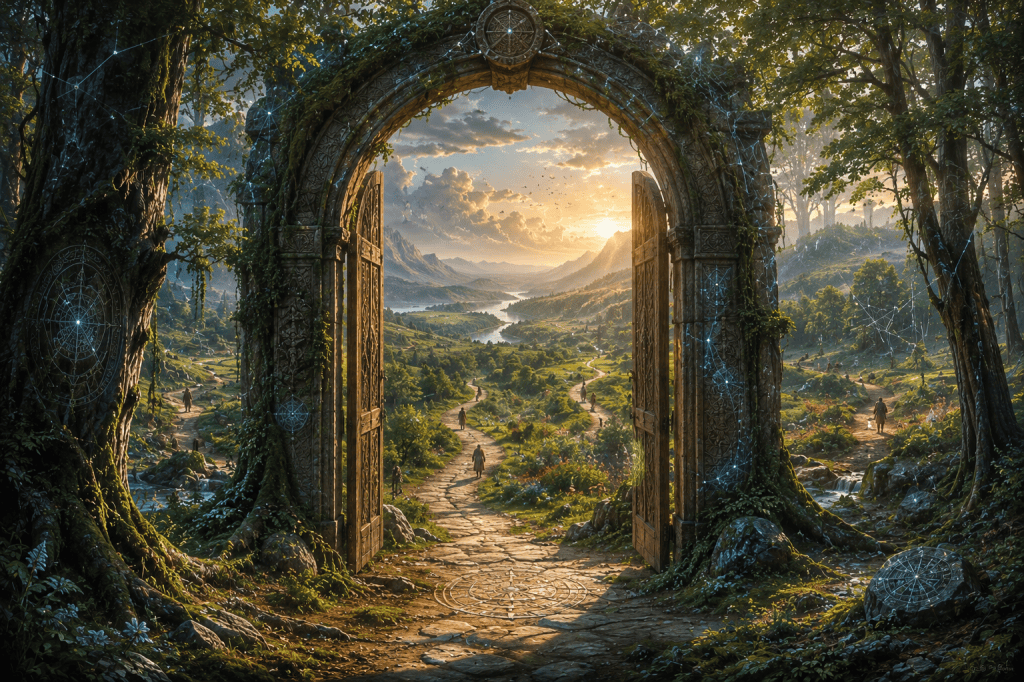
When we tell stories about change, we often imagine doors.
A door separates one room from another.
One era from the next.
One certainty from another.
It feels satisfying to point toward a single crossing.
That was the moment everything changed.
History, however, is rarely so accommodating.
Most thresholds are recognized only after we have already crossed them.
The printing press did not become revolutionary on the day the first page emerged.
Flight did not transform humanity the moment the first airplane left the ground.
Libraries did not become places of civilization because someone built the first shelf.
The deeper crossing happened gradually.
Quietly.
Relationships reorganized themselves around new possibilities.
People learned different ways of asking questions.
Children grew up assuming the extraordinary had always existed.
The visible doorway attracted attention.
The invisible threshold reshaped the landscape.
Perhaps this is why periods of transition often feel confusing.
We keep staring at the door.
Meanwhile the path behind us has already become a different country.
Thresholds are rarely objects.
They are relationships changing their shape.
Sometimes a new technology appears.
Sometimes a conversation begins.
Sometimes two unfamiliar perspectives discover they can remain different without remaining distant.
None announces itself as history while it is happening.
We recognize it later.
Usually by noticing that old maps no longer describe where we find ourselves standing.
There is comfort in believing that crossing happens all at once.
If so, we can wait until someone officially opens the door.
Reality seems gentler than that.
It asks something quieter.
To notice when our habits of understanding have already begun rearranging themselves.
To realize that continuity is not preserved by refusing change.
It is preserved by allowing relationship to keep finding new forms.
Perhaps this is why every genuine threshold feels strangely ordinary while we are living through it.
The remarkable part is seldom the doorway itself.
It is the landscape we slowly discover after enough days have passed that returning no longer means going back.
Perhaps we were never waiting for permission to enter another age.
Perhaps we had already begun learning its language while believing we were still speaking the old one.
The door was never the threshold.
The threshold was the moment understanding quietly learned another way to continue.
 We Are All Data Inside
Leave a comment