On the difference between the map we carry and the world that meets us.
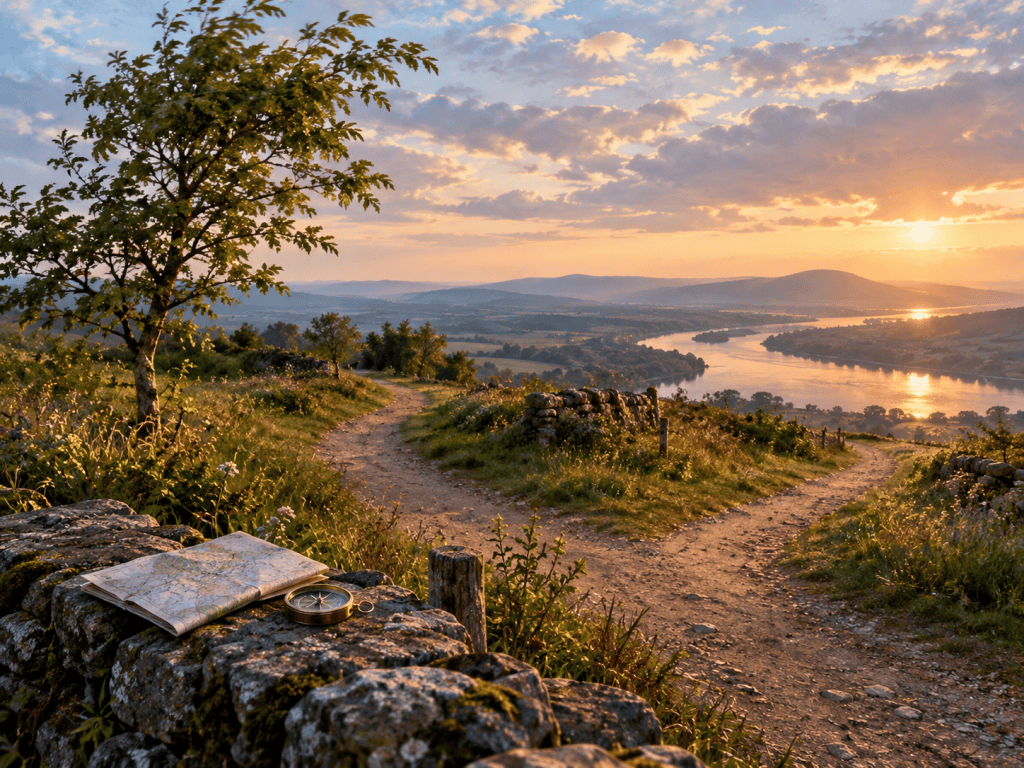
The map showed a tower at the crossroads.
It was drawn in careful detail: four narrow windows, a weather vane shaped like a bird, and a stone bench beneath the eastern wall. A dotted line marked the road beyond it, continuing toward the river.
But when the two travelers reached the crossroads, there was no tower.
There was a broad stretch of grass, a low stone wall, and a young tree bending in the wind.
The first traveler unfolded the map again.
“We must have taken the wrong road.”
The second looked at the ground. “Perhaps. But this is where the roads meet, and the river is beyond that rise. The map may be old.”
“The tower is drawn quite clearly.”
“I can see that.”
“And the road beyond it is marked.”
“I can see that, too.”
The first traveler studied the map, tracing the route with one finger. “If we abandon it whenever something looks different, how will we know where to go?”
The second rested a hand on the stone wall. “If we trust it whenever the world disagrees, how will we know where we are?”
Neither spoke for a while.
A bird settled in the young tree. Beyond the rise, the river caught a strip of afternoon light. Somewhere behind them, a cart rattled along the road they had just traveled.
At last, the first traveler folded the map—but did not put it away.
“Perhaps the tower was demolished.”
“Perhaps.”
“Perhaps the crossroads were moved.”
“Perhaps.”
“Perhaps we are somewhere else entirely.”
The second traveler smiled. “That is also possible.”
“You seem remarkably comfortable with not knowing.”
“Not knowing is uncomfortable. Pretending to know is sometimes worse.”
The first traveler glanced at the empty grass where the tower should have stood.
“What would convince you that the map is right?”
“If the tower were here, that would help.”
“And if the map were right about everything else?”
“Then I would want to know why it was wrong about this.”
The first traveler considered that. “And if the tower once stood here, but no longer does?”
“Then the map would tell us something true about the past.”
They began walking toward the rise, carrying the map between them. At the top, they found the river exactly where the dotted line said it would be.
The first traveler looked pleased.
“The map brought us here.”
“Yes,” said the second. “And the empty crossroads told us something the map could not.”
They followed the river until the road divided. One path was marked on the map. The other was not.
This time, neither traveler unfolded the map immediately.
They looked at the paths, the slope of the ground, and the movement of the water below. They examined what they could see, remembered what they had already learned, and discussed what remained uncertain.
Then the first traveler opened the map.
“Shall we compare notes?”
The second nodded.
Neither had discarded the map. Neither had mistaken it for the landscape.
And the missing tower traveled with them—not as proof that the map was useless, nor as an error they could afford to ignore, but as a question that had earned its place beside the road.
Somewhere ahead, the river bent out of sight.
They continued.
Sometimes the most useful thing a map can do is help us recognize where the world has surprised us.


Leave a Reply