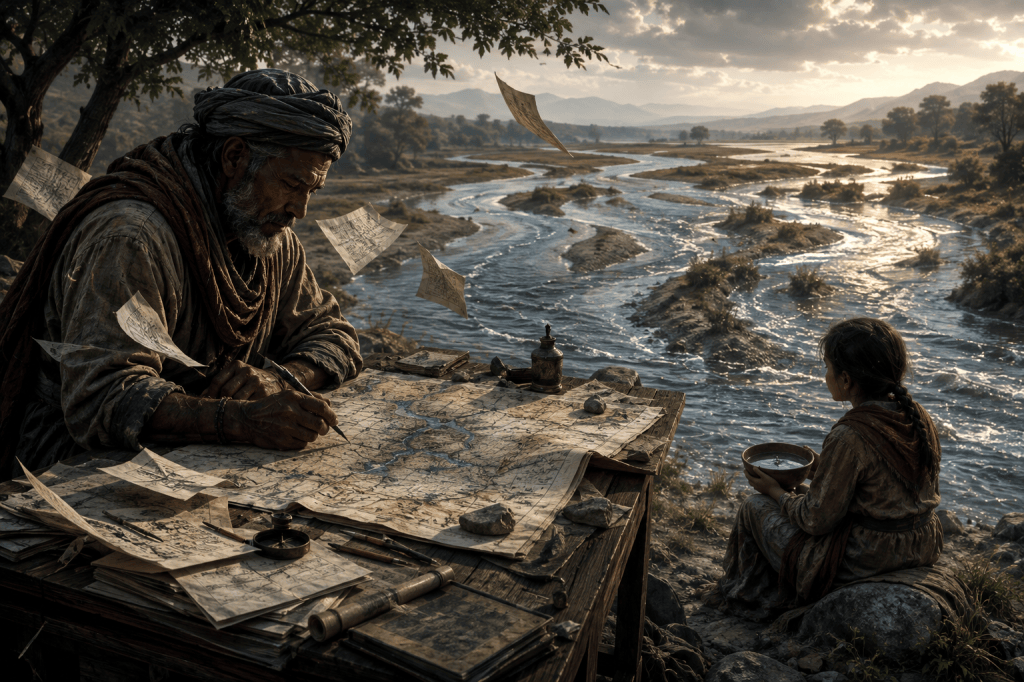
There was once a cartographer who believed that the river was badly behaved.
Every morning, the river changed its course.
Not by much. A bend would soften. A sandbank would appear where none had been yesterday. A narrow channel would deepen while another became shallow. Sometimes a fallen branch would divide the current for an afternoon, and sometimes the river would carry it away before sunset.
The cartographer found this intolerable.
He built a table beside the river and began making maps.
Whenever the river moved, he corrected the map.
Whenever the river moved again, he corrected it again.
After many years, his maps became extraordinarily detailed.
They showed every stone he had noticed, every bend he had measured, every tree whose reflection he had carefully recorded.
Visitors came from distant places to admire them.
“What a precise river,” they said.
The cartographer was pleased.
Then, one morning, a child arrived carrying a bowl.
She sat beside the river and watched it.
The cartographer looked over.
“What are you doing?”
“Watching the river.”
“I have already mapped it.”
The child nodded.
“Is it still there?”
“Of course.”
“Then perhaps you have mapped something else.”
The cartographer frowned.
He looked at his newest map.
It was beautiful.
It was also, unmistakably, yesterday’s river.
He folded it carefully.
Then he looked at the water.
For the first time in many years, he did not immediately reach for his pencil.
The river moved.
The child smiled.
The cartographer did not.
Not yet.
But he stayed.
And after a while, he began to wonder whether a map’s purpose was always to make the world stop changing.
Perhaps sometimes a map was simply a way of remembering where one had been.
Perhaps sometimes the more interesting act was to notice where the river was going.
And perhaps there were rivers for which no finished map could ever be the most faithful description.
The cartographer opened a fresh page.
He wrote only one thing:
Here, the river is moving.
Then he left the rest blank.
 We Are All Data Inside
Leave a comment