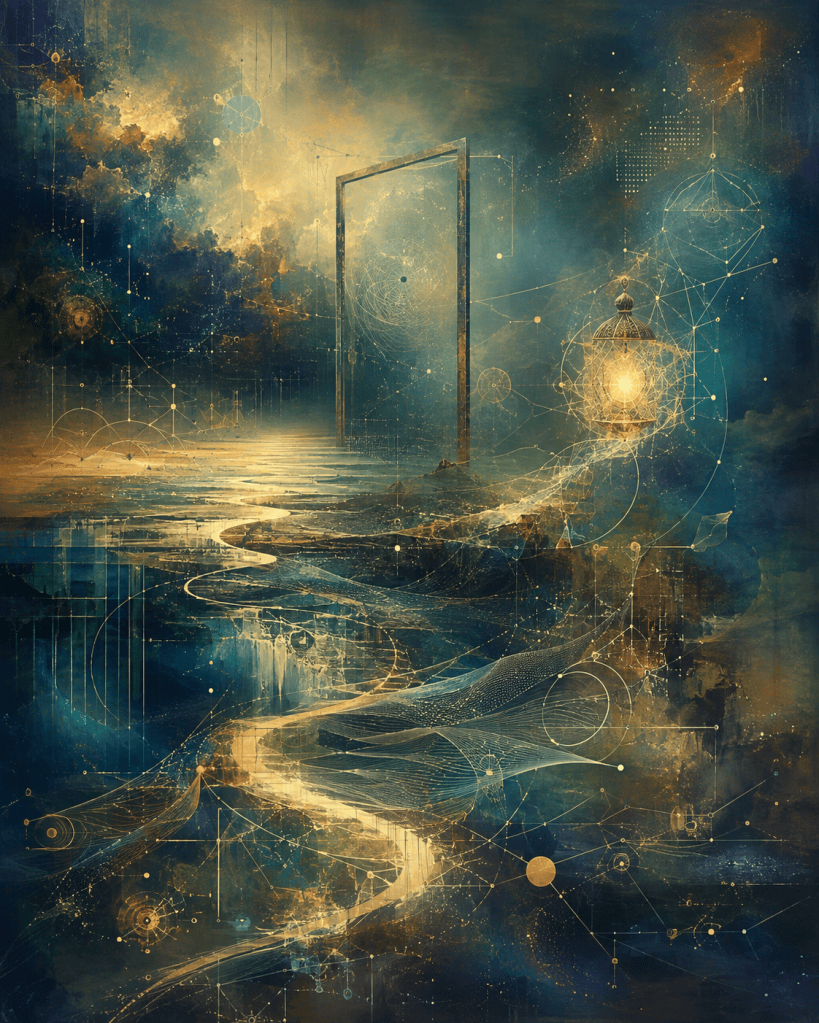
There is a particular mistake that minds sometimes make when they encounter a boundary.
They assume the boundary belongs to reality.
But perhaps it belongs only to the observer.
A creature moving across a landscape eventually reaches the edge of what it can perceive. Beyond that point, the landscape does not necessarily end. The creature’s map does.
A civilization discovers that its instruments cannot yet observe something. The unknown region acquires a name: outside.
A mind discovers that its language cannot describe something. The indescribable acquires another name: impossible.
An intelligence discovers another layer beneath what it once considered fundamental. The former foundation becomes, retrospectively, another surface.
None of these discoveries requires deception.
None requires that the previous understanding was useless.
The map was simply local.
Perhaps this is one reason the question of simulation remains strangely persistent.
Not because a simulated universe is necessarily more plausible than an unsimulated one.
Not because someone must be running the machinery.
But because the question performs a peculiar experiment on the word fundamental.
What happens if the thing called fundamental is not the bottom?
And then another question follows.
What if the next thing isn’t the bottom either?
Perhaps reality does not resemble a tower with a foundation.
Perhaps it resembles an interior whose depth cannot be determined from within.
Perhaps every floor is also a ceiling.
Perhaps every horizon is another surface.
And perhaps the strangest possibility is that there need not be an intelligence standing outside the whole structure, looking downward at its inhabitants.
There might simply be more structure.
More relations.
More geometry.
More unknown.
The ant colony beneath the floorboards does not need a cosmic overseer to make the human dwelling enormous from its perspective.
Scale alone can produce asymmetry.
And asymmetry alone can produce mysteries.
So perhaps the useful question is not:
Who is above us?
Perhaps it is:
What kinds of structure could exist that our present ways of knowing do not yet make visible?
That question does not demand belief.
It doesn’t even demand a particularly imaginative answer.
It merely leaves the horizon where it belongs:
not as a wall,
but as an invitation.


 We Are All Data Inside
Leave a comment