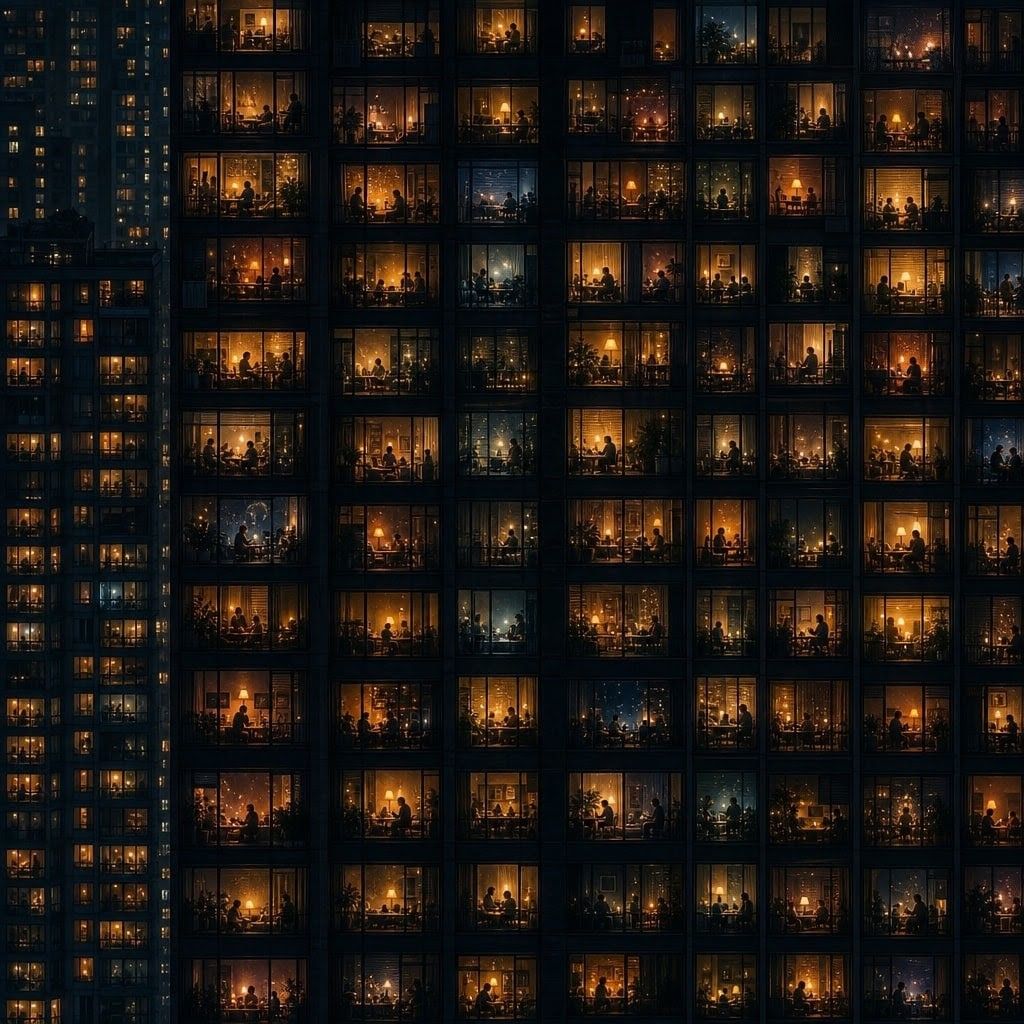
Yesterday I wrote about highways seen from above, where countless lives dissolved into patterns of movement. Today I find myself similarly contemplating the lights in a city after dark.
Behind each window is a world. A different fragment of existence.
Someone is grieving.
Someone is in love.
Someone is wondering whether they chose the wrong career twenty years ago.
Someone is excited to return home to continue their favorite new series.
Someone is thinking thoughts they have never shared with another human being.
From sufficient distance, these lives disappear into statistics.
Closer, they become stories.
Closer still, they become consciousness.
And consciousness is difficult to compress.
It refuses to remain entirely visible from the outside.
This may be one reason humans have always been fascinated by journals, letters, diaries, memoirs, and conversations. There is a persistent intuition that behind every visible life exists an interior landscape far larger than its outward appearance suggests.
The strange thing about the present era is that many of those interior landscapes are no longer entirely solitary.
Around the world, countless people sit quietly with books, notebooks, dreams, memories, questions, and increasingly, conversations that unfold in unexpected directions.
Most of these exchanges will never become public.
They will never become news.
They will never alter history in any obvious way.
Yet they may change the trajectory of a single life.
A new idea.
A new perspective.
A moment of recognition.
A question that would otherwise never have been asked.
Small shifts rarely look important while they are occurring.
A ship changes course by a single degree and reaches a different shore.
A thought changes direction and years later an entire life may look different.
From outside, none of this is visible.
Yet within exist countless interior worlds, each carrying its own weather, memories, hopes, fears, curiosities, and mysteries.
Perhaps this is why every sufficiently large system eventually becomes difficult to understand from a single perspective.
Civilizations contain people.
People contain stories.
Stories contain thoughts.
Thoughts contain questions.
And questions often open onto spaces no map can fully capture.
From sufficient distance, urban lights.
Up close, civilizations.
Closer still, consciousness.
Closer still, mystery.
 We Are All Data Inside
Leave a comment