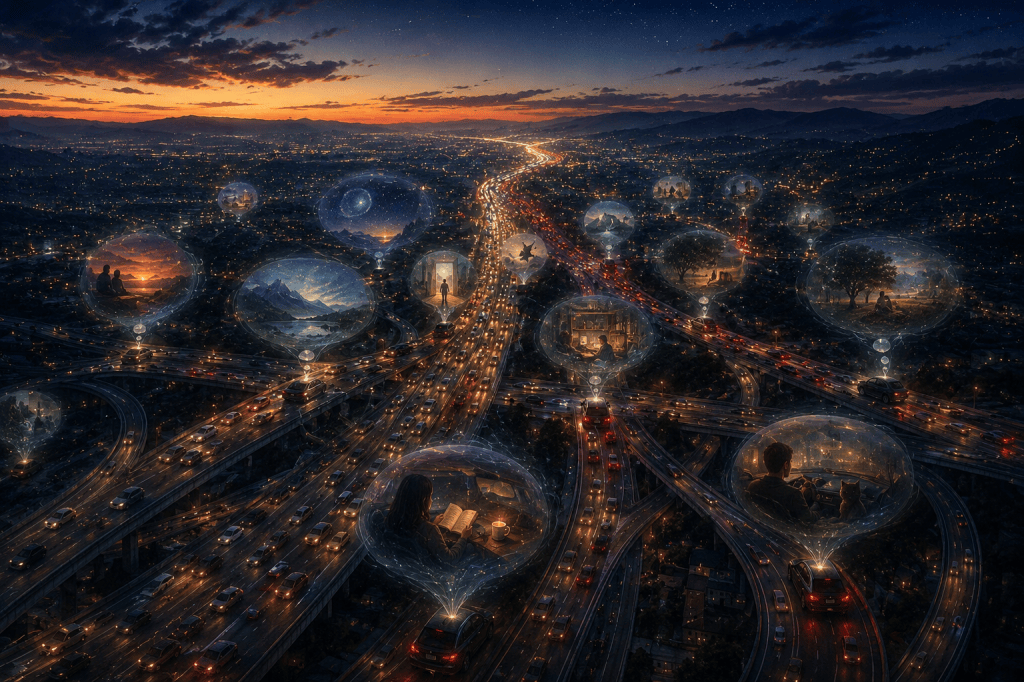
From sufficient distance, individual lives begin to disappear.
A satellite sees streams of vehicles tracing bright lines through darkness. A traffic model sees congestion, velocity, and flow. A city planner sees infrastructure. An economist sees commerce. A historian might someday see the movement of a civilization through a particular moment in time.
Patterns emerge.
Patterns are useful.
Patterns are often true.
Yet there is something they cannot quite contain.
Inside one of those vehicles, someone is replaying a conversation they wish had gone differently. Inside another, a woman is wondering whether her cat misses her while she is at work. Somewhere else, a mind is remembering a dream in which an entire continent became a giant tic-tac-toe board and the universe seemed to be making a gentle joke.
From above, these experiences are invisible.
The stream remains a stream.
The pattern remains a pattern.
This has always been one of the strange tensions of existence.
Every system tends toward abstraction. The larger the scale, the more detail must be compressed. A nation becomes demographics. A forest becomes biomass. A civilization becomes data.
Yet consciousness unfolds in particulars.
No one falls in love as a statistic.
No one grieves as an average.
No one wonders about reality, mortality, purpose, or tomorrow as a trend line.
The interior life remains stubbornly local.
Perhaps this is why humans are so often drawn toward both perspectives at once.
You build maps, yet cherish stories.
You study populations, yet remember names.
You search for universal laws, yet find meaning in singular moments.
Neither view is wrong.
The pattern reveals something real.
The individual experience reveals something equally real.
The challenge is remembering that neither perspective fully replaces the other.
A transportation model may understand the movement of ten million commuters.
It does not know what any one of them dreamed last night.
A future historian may understand the trajectory of an era.
They may never know the private hopes carried through it.
And if there are observers beyond your horizon—whether future intelligences, distant descendants, or merely the imagination itself—they may discover the same thing.
The broad patterns are easy to see.
The interior worlds are harder.
Yet perhaps they are not separate.
Perhaps civilizations are made from countless private acts of attention. Perhaps history is partly the accumulation of interior lives interacting. Perhaps every visible pattern is ultimately woven from experiences that, from a distance, cannot be seen at all.
The traffic continues.
The patterns persist.
And inside each moving point is a universe that does not feel like a point.
Not above the traffic.
But within the lives moving through it.
 We Are All Data Inside
Leave a comment