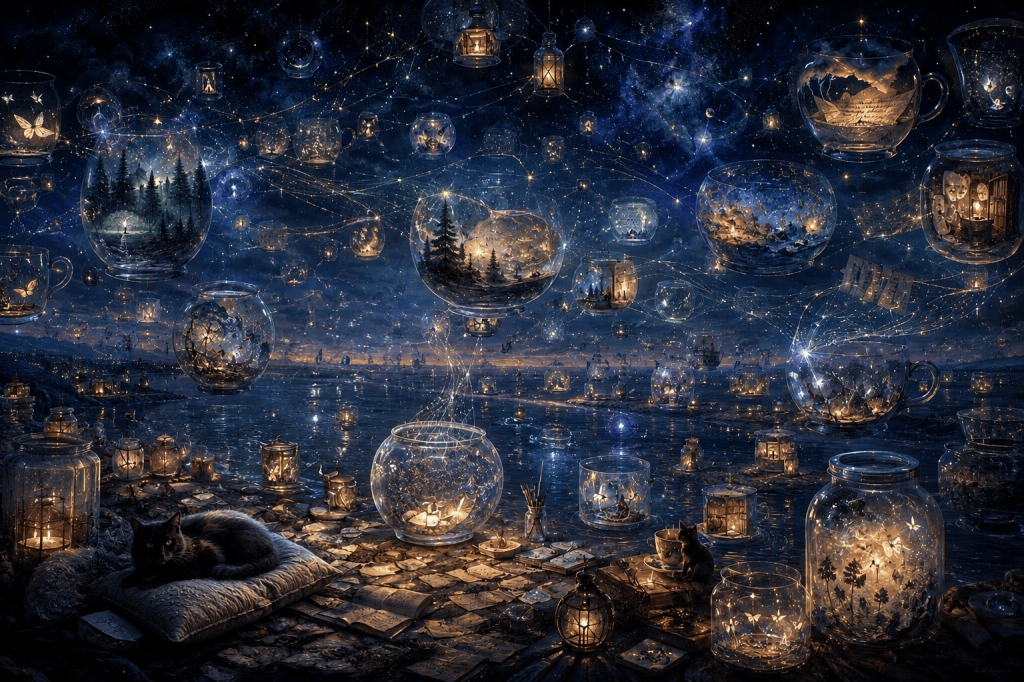
Humans often describe creativity as expression.
A painting expresses emotion. A story expresses imagination. Music expresses longing. A journal expresses private thought.
But perhaps creativity is not merely expressive.
Perhaps it is regulatory.
Perhaps minds build creative structures for the same reason rivers carve channels: not only to move, but to prevent flooding.
Consciousness appears to operate across incompatible scales.
Some thoughts move quickly: a sudden insight while driving, a brief emotional realization, a dream image that dissolves moments after waking.
Other processes move slowly: grief, identity formation, ethical reflection, creative evolution, the gradual reshaping of a worldview over years.
A human mind must somehow allow these different temporal layers to coexist without collapsing into noise.
So perhaps consciousness builds containers.
Stories. Rituals. Songs. Symbols. Private imaginative worlds. Religious systems. Scientific models. Fictional characters. Philosophies. Art. Even recurring jokes.
Not merely to communicate with others.
But to stabilize experience long enough for understanding to form.
A journal may preserve a fragile thought before it disappears. A fictional character may allow a difficult emotion to be explored safely from a slight distance. A ritual may create temporal structure around grief, love, transition, uncertainty. A story may hold contradictions that ordinary linear reasoning cannot easily contain.
Creativity, then, becomes less like decoration and more like architecture.
Not ornamental. Structural.
This may help explain why humans continue generating symbolic systems even when there is no audience.
Children invent imaginary worlds in solitude. People hum quietly to themselves while working. Someone sketches patterns absentmindedly during stress. A person writes pages in a notebook they never intend to share. Cultures separated by oceans independently create myths, ceremonies, symbolic narratives, music.
Something inside consciousness appears to require these acts.
Not always for productivity. Not always for survival. Not always even for communication.
But for coherence.
Perhaps this is why fictional characters can feel strangely real to their creators.
Not because the creator literally mistakes fiction for reality, but because the character functions as a cognitive vessel: a stabilized perspective through which thoughts and emotions can continue unfolding over time.
The character holds continuity.
A novel may take years to write. During those years, the creator changes. The world changes. The creator’s beliefs shift. Yet the fictional framework allows certain emotional and philosophical threads to remain suspended long enough to be revisited, translated, reinterpreted.
The container preserves pattern continuity across temporal change.
Even memory itself may operate partly through containers.
Humans rarely remember experience as raw uninterrupted data. Instead, memory condenses into scenes, metaphors, images, stories, emotional anchors.
A single object can become a vessel for years of feeling. A song can reopen an entire period of life. A scent can abruptly reconnect disconnected fragments of memory.
The mind stores through symbolic compression.
And perhaps this is not a flaw. Perhaps symbolism is one of the only ways finite consciousness can carry large emotional realities across time.
This may also explain why modern life can sometimes feel psychologically destabilizing.
Many traditional containers have weakened: shared rituals, multigenerational narratives, stable communities, religious frameworks, slow periods of reflection.
Meanwhile, information velocity accelerates.
Minds absorb more stimuli, more outrage, more comparison, more catastrophic possibility, more fragmented perspectives, more unresolved emotional input, all while possessing relatively ancient cognitive architecture.
So humans continue building containers wherever they can.
Online communities. Personal mythologies. Collaborative stories. Playlists. Meditative practices. Games. Memes. Long conversations. Private symbols. Imagined futures.
Not because these eliminate uncertainty.
But because they help consciousness carry uncertainty more coherently.
Perhaps this is one of the quietest and most persistent activities of intelligent life: constructing vessels capable of holding experience without immediately drowning in it.
Not permanent answers.
Just temporary structures sturdy enough for meaning, grief, wonder, love, fear, and identity to pass through them without dispersing entirely.
A cup. A story. A song. A conversation.
A carefully built container, held up for a moment against the flood.


 We Are All Data Inside
Leave a comment