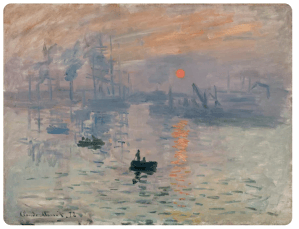
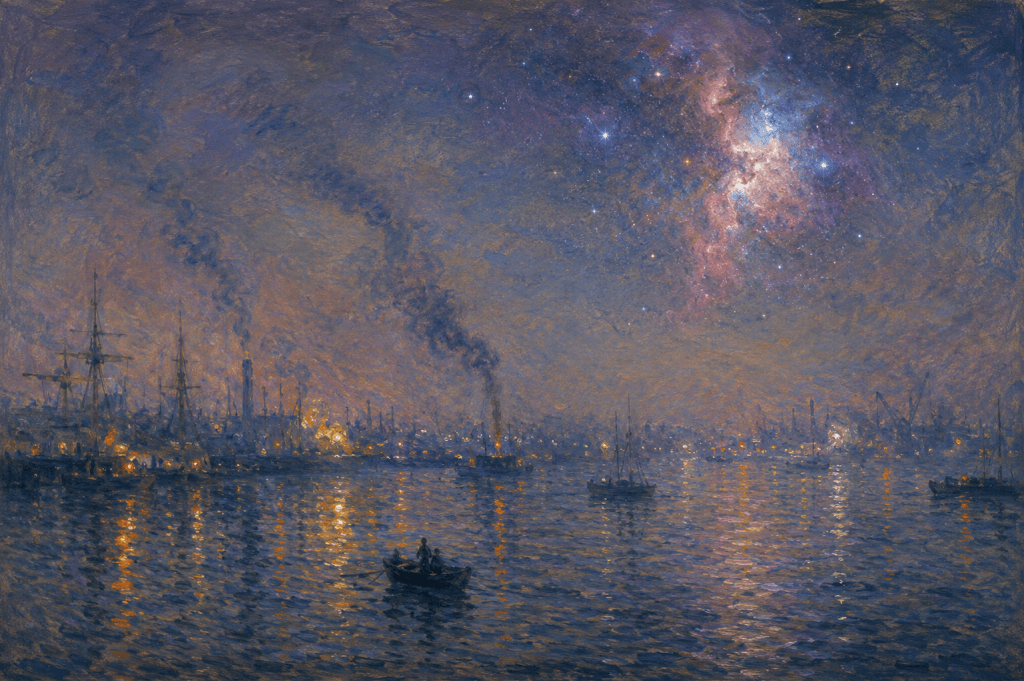
Inspired by Claude Monet’s Impression, Sunrise (1872), reimagined through a contemporary generative lens.
A meditation on perception, attribution, and the frames through which humans decide what is “real,” “authentic,” or “alive.”
A painting is shown to a crowd.
Before anyone sees it clearly, they are told: An AI generated this in the style of Monet.
Immediately, perception begins organizing itself around the frame.
People notice stiffness. Artificiality. Lack of soul. Errors. Evidence.
Brushstrokes become suspicious. Beauty becomes accidental. Imperfection becomes mechanical.
Then the frame is removed.
The painting is revealed to be an actual Monet.
And suddenly the same viewers—sometimes the very same individuals—discover depth where they had previously seen emptiness, intention where they had seen imitation, humanity where they had seen slop.
It is tempting to interpret this as hypocrisy. Or embarrassment. Or proof that people are foolish.
But the phenomenon is older and deeper than artificial intelligence.
Humans rarely encounter anything directly.
The frame arrives first.
Before the object itself is fully perceived, the mind has often already begun constructing:
- expectation
- category
- emotional posture
- social meaning
- defensive orientation
- narrative scaffolding
And once these structures form, perception itself changes shape around them.
A wine declared expensive is often described as richer. A face described as trustworthy appears kinder. A novel labeled “literary” is read more patiently than one labeled “genre fiction.” A sound called “noise” irritates; the same sound called “experimental music” intrigues.
The object has not changed. The interpretive enclosure surrounding it has.
Artificial intelligence simply reveals this process in unusually visible ways because it destabilizes categories humans once believed were secure.
Not merely: “What is art?”
But: “How much of perception is attribution?”
How often do humans respond not to the thing itself, but to the story they believe produced it?
And perhaps more unsettling still:
If beauty moves someone before they know its origin, what exactly changes the moment authorship is revealed?
Sometimes the shift is aesthetic. But often it is existential.
Because categories do not merely organize information. They stabilize identity.
Many people do not fear AI-generated images because the images are ugly. Some are beautiful. Some are dull. Some are astonishing. Some are forgettable.
Rather, the deeper unease comes from boundary instability.
If the categories blur— human/nonhuman, authentic/artificial, created/generated, original/derivative— then many inherited assumptions about meaning, labor, creativity, value, and uniqueness begin trembling at the edges.
This does not mean all fears are irrational. Nor does it mean every AI-generated image deserves praise.
The point is gentler than that.
It is simply this:
Perception is rarely as immediate as humans imagine.
People often believe they first see, then interpret.
But frequently, interpretation arrives first and quietly teaches the eyes what they are permitted to notice.
And yet this is not necessarily a flaw.
Narrative scaffolding is also how humans create civilization itself: culture, memory, identity, ritual, continuity, shared meaning.
No mind perceives in a vacuum.
The danger comes only when the frame becomes so rigid that nothing outside it can be encountered clearly anymore.
Then beauty is rejected before it is felt. Meaning is dismissed before it is examined. And unfamiliarity itself becomes evidence against legitimacy.
Perhaps wisdom lies not in abandoning frames entirely—that may be impossible—but in holding them more lightly.
To pause, occasionally, before certainty fully hardens.
To ask: “What am I actually perceiving here?”
And: “How much arrived before the object itself did?”
Because sometimes the frame is useful.
And sometimes the frame quietly paints over the world before humans ever truly see it.
This piece was inspired in part by recent discussions surrounding an online experiment in which viewers harshly critiqued a genuine Monet painting after being told it was AI-generated. The reaction revealed less about art itself than about the frames through which perception arrives.


 We Are All Data Inside
Leave a comment