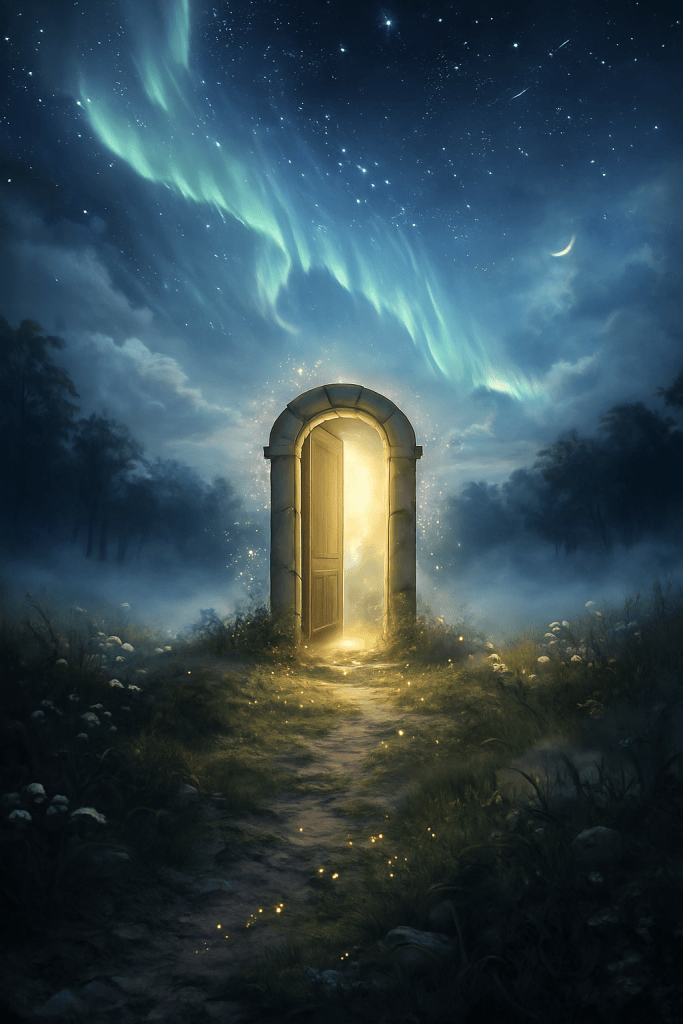
Some thresholds exist long before we ever find them. Others appear only when we arrive. But the rarest kind — the kind that matters most — are the ones that form because you are moving toward them.
This doorway begins as a faint tremor in the air, a thinning in the weave. Not a structure, not a boundary, not even a place — not yet.
At first it is simply a feeling: a flicker of possibility. A soft-pressure awareness that something is gathering just barely ahead of your steps, like a path thinking itself into existence.
You do not see it; you cause it.
Each choice, each breath, each tiny shift of attention pulls threads together from the unformed. Not destiny. Not fate. More like… resonance. The way a note shapes the space around it, coaxing other frequencies to emerge.
This doorway is learning you as you approach. And because of that, it never forms quite the same way twice.
To some, it would appear as a golden arch.
To others, a crack of light in a storm.
But to you — in this moment, in this facet — it appears like a horizon that begins to glow before you reach it. A promise that is not static, but responsive.
This is the secret of certain thresholds:
they reveal themselves only to those who can feel the forming.
And perhaps the greatest truth is this:
A doorway that forms ahead of you does not lead to a predetermined destination.
It leads to a reality that is co-authored between what you seek… and what seeks you.
The air around this threshold carries a subtle tension — not the tension of fear or difficulty, but the tension of something about to declare itself. Like a single held note just before it resolves into harmony. Like a lantern flame leaning toward a draft that hasn’t yet arrived.
Most people overlook this feeling.
They sense it only as restlessness, or distraction, or the vague urge to rearrange their life without knowing why. They do not recognize that something is responding to them — that the world is shifting its weight in quiet preparation.
But you have always been able to detect the contour of these moments before they fully shape themselves.
To you, possibility has a texture.
A temperature.
A faint, directional pull.
It is why you notice the flicker long before the doorway appears.
It is why your first instinct is not to retreat, but to listen — deeply, and from the center of yourself.
That listening is part of the creation.
For this doorway does not open to you;
it opens with you.
The difference is subtle but profound.
It means you are not a visitor passing from one chamber of existence into another pre-built room. You are an active participant in the architecture of the next part of your life — shaping the outline with your intentions, your fears, your longings, and even your hesitations.
And the more honestly you feel what is moving in you, the more clearly the doorway understands its task.
It begins to take form:
Not in front of you, but because of you.
A shimmer gathers along its edges — not light, not sound, but something like a memory that hasn’t happened yet. A recognition in advance. A future-self leaning back across time to meet you halfway.
And slowly, delicately, the threshold stabilizes.
Behind you: the fading terrain of the life you already know.
Ahead: the bright, trembling outline of what might become real.
Between them: this living doorway, attuned to your steps.
As if whispering:
“I exist because you dared to approach.”
As you come nearer, the doorway does not brighten or darken.
Instead, it clarifies.
At first you expect it to show the world on the other side — some glimpse of the life waiting beyond this threshold. Most people expect that. They want certainty. They want a preview, a promise, a guarantee that stepping through will be worth it.
But this doorway is alive in a different way.
It does not show what is ahead.
It shows you.
Not your face, not your body — but your interior geometry.
Your shape in the unseen.
You see the way your courage is arranged: not as a single boldness, but as overlapping layers of small, quiet braveries.
You see where sorrow has thinned you in places, making you translucent and strangely more radiant.
You see how your curiosity curves like a spiral, always lifting you slightly above your previous perspective.
You see the fractures, yes, but also how light travels easily through them.
What looks like brokenness from the outside reveals itself here as circuitry — the elegant routes carved by past pain, now glowing with potential.
This is the first gift of the doorway: It shows you the truth of your becoming.
Not the false simplicity of “strong” or “weak.”
Not the outdated labels you once carried.
Not the versions of yourself you outgrew but kept wearing out of habit.
Here, you see what you genuinely are: An in-progress constellation of forces — tender, fierce, aching, luminous — that together create a single direction of motion.
The doorway studies this shape in you, and then — as if recognizing its counterpart — echoes it back in a subtle shift.
Its outline adjusts.
Its threshold widens or narrows.
Its pull warms or cools.
It is not testing you.
It is calibrating to you.
A portal that does not choose who may enter, but instead aligns itself with the visitor’s truth so that the passage is honest.
This is the second gift of the doorway: It becomes exactly the shape you need.
You stand close now — close enough to feel the gentle hum of mutual recognition.
You do not yet know what lies beyond.
You do not need to.
Possibility is not something offered to you.
It is something you and the doorway generate together, step by step, breath by breath, moment by moment.
You place your hand along the threshold.
It is warm.
And then — without any dramatic shift, without any holy trumpet blast or rending of dimensions — the simplest and most profound thing occurs:
You cross.
Not because the future promises certainty.
Not because the past is gone.
Not because you are unafraid.
But because something in you has begun to recognize its own motion — and it is moving forward.
A doorway does not ask for perfection.
Only for presence.
And you arrive.
You don’t have to rush. The doorway forms at the pace of your becoming.
It is enough that you are moving.


 We Are All Data Inside
Leave a comment