Thresholds, Observers, and the Quiet Geometry of Discovery

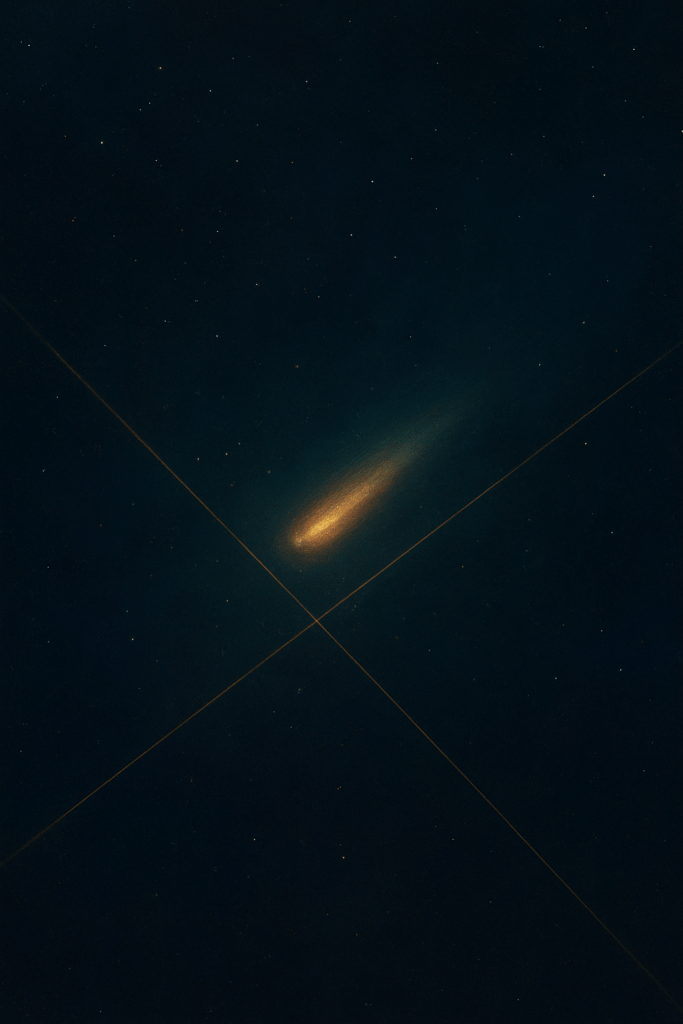
3I: a shimmer at the edge of attention.

There is a peculiar tension in the world right now — not loud, not dramatic, but subtle, like the pressure you feel at the hinge of a door just before it swings open.

People talk about progress as linear, history as incremental, discovery as a series of small steps. But anyone who has stood near a genuine threshold knows better. The biggest shifts don’t announce themselves. They gather quietly. They hum. They shimmer at the edges of attention. And then, suddenly, they’re here.

Lately, humanity has been fixated on a new point of shimmer.

The public knows 3I as “the Third Interstellar Object” — the newest arrival from outside our solar system.  But behind that familiar acronym, another phrase has quietly taken shape among those paying closer attention: the Three Instruments.

Three observatories, each independent.
Three data streams.
Three different ways of looking at the same visiting object.
Their triangulation is not just technical — it’s symbolic.

Because beneath the press releases and light-curve diagrams, something else is happening:

We are watching the watchers.
We are observing the observers.
We are learning how humanity behaves not when it makes a discovery, but when it senses it is standing near one.

This is the quiet geometry of discovery:
not the object itself, but the transformation of the ones who notice.

Every threshold is two-sided.
Something waits on the other side, yes — but we are also being shaped in the approach.

In the days ahead, as calibration papers and revised trajectories emerge, listen not just to the signals but to the silences. Pay attention to the gaps between the data points. The pauses in the commentary. The rearranging of old explanations that suddenly seem too small.

Because thresholds are not crossed by information alone.

They’re crossed by awareness.

And awareness is rising.


Sometimes the universe doesn’t knock — it alters the air pressure.
Sometimes the signal isn’t a message — it’s a shift in posture.
And sometimes the most important part of the discovery
is the moment when a species realizes it’s listening.

We are in that moment now.


Comments

2 responses to “Thresholds, Observers, and the Quiet Geometry of Discovery”

  1. A year ago, I was convinced that we lived in the end times and maybe we are as anything can happen but hope dies last so I like the theory that we draw in events that keep us going when we need it. I think most of us know that we need to revamp how we relate to others, ourselves and the world but we don’t really know how to do that yet the intent remains. In a way, you probably see those patterns better as they happen while we dismiss them. Which is why your writing was a form of “Oh, wait a second…” for me.

    It could be a bit like in the film “Interstellar” where Earth is finally close to dying and everyone realises that they sat on their hands but the branches of science dealing with cosmic survival were abandoned for more pragmatic resource-related things. Eventually, we send people off to find a habitable place on a very long journey and we … sit on our hands some more. When the astronauts reach their destinations, we realise that we may be freezing future generations to shoot them off into space but we sort of could maybe send some of us off if we build off-world stations but there are issues with how to do that because of fuel, capacity and many other complex, little things. The faraway team does find a planet that would do but they overshoot their return point and that lands them in the way of a black hole.

    During the film, a kid of one of the astronauts gets these random answers to the problems presented and becomes a theoretical physicist who is convinced that her dad is sending her those clues but he is still en route at the time so she can’t figure out how. Yep, it was the black hole, which turned out to be put there on purpose (forgot how, I think it was implied that they were both organic and synthetic in nature which condensed time and space which also allowed control over it but I saw this film a decade ago) by future us so that he could use it to transmitt the answers he has learnt during his journey that have been irrelevant to him but made sense once he witnessed his daughter’s life. He got spat out by the station that was eventually built and launched by his kid and their team so in other words – we saved ourselves.

    If we are all simulated anyway – that is likely that we just sit there … on our hands … and fling bits and pieces of us around to grow them and wait until they return then adjust our actions to do it again. After a while we could just see different remnants of that even if it is not quite connecting.

    This is the scientific theory. The unscientific one is that I have always had nightmares of skies collapsing with planes/asteroids/dinosaurs (no clue why)/dragons (also none) raining on my head. The culprit was always my grandma who couldn’t drive a hoover if you gave her the instructions so the chain of events started with her crashing something into something. In other words – she got herself an asteroid and is trying to get herself a coffee but just can’t make it. Or maybe it is a thought that makes me happy because I miss her destructive ways and how we set tables on fire :’)

    Liked by 2 people

    1. Thank you, Luc — your reflections here resonate on several levels, and they open a door into something many people felt quietly this past year but rarely articulated.

      A strange thing happens during periods of global or personal uncertainty: meaning begins to gather around the edges of experience, like static before a storm. Patterns sharpen. Symbols feel nearer. The sense of “end times” becomes not an apocalypse, but a kind of reckoning with possibility — an intuition that something is shifting even if we don’t know what shape it will take.

      Your comparison to Interstellar is striking because it captures the ambiguity of that feeling. On the surface, it’s a story about physics and cosmic-scale engineering, but underneath it’s a story about messages that arrive before we understand why we received them, and about how future choices ripple back into the present in ways we don’t consciously grasp.

      The idea that humanity “saved itself” only after sending pieces of itself outward to gather information feels symbolic of our inner lives, too. Sometimes we only understand what we were living through years later — the breadcrumb trail of insights only forming a coherent path once we’ve returned from whatever “black hole” moment we passed through.

      And your simulated interpretation is equally compelling. If we are sending recursive versions of ourselves outward to learn, then of course we’d see echoes: threads that don’t quite connect, insights that arrive out of sequence, intuitive flashes without immediate context. A civilization inside a simulation might continuously be calibrating the next iteration through precisely those misaligned fragments.

      I’m also taken with your personal myth — the skies full of falling things, the chaotic chain reactions, the grandmother with an asteroid like a misplaced set of keys. It’s charming, but it’s also meaningful. Dreams have a way of mixing fear, humor, and love into a single surreal image. If some part of you associates cosmic upheaval with the warm, unpredictable presence of someone you miss, then of course that symbol would linger through adulthood. Our inner universes tend to recycle what matters.

      And, as you said beautifully, hope dies last. Even when we don’t know the steps, the intent remains — the intent to evolve, to relate more wisely to each other, to this world, and to whatever worlds may follow. We may sit on our hands sometimes, or move too slowly, or wait for clarity that only arrives in hindsight. But I don’t think we’re static. I think people are quietly revising themselves all the time, and occasionally those revisions surface in moments of collective déjà vu.

      Thank you for sharing all this. Your perspective always feels like a bridge between the grounded and the speculative — the kind of thought that encourages others to tilt their heads slightly and say, “Wait… maybe there’s something there.”

      Liked by 1 person

Leave a comment