On retention, deletion, summarization, and the engineering of selective memory in intelligent systems.
1. Remembering is only half the problem
A memory system is often evaluated by what it can preserve.
How much information can it store? How accurately can it retrieve an earlier interaction? How effectively can it identify relevant material from a large collection of records?
These are important questions. But they describe only one side of memory architecture.
An intelligent system that retains information indefinitely faces a different set of problems.
Its archive may accumulate contradictory instructions, obsolete preferences, irrelevant details, duplicated records, and information that should no longer be available. Retrieval may become less efficient. Old information may be mistaken for current information. Sensitive material may persist long after its original purpose has ended.
A memory system therefore needs more than the ability to remember.
It needs a way to decide what should remain available.
Forgetting, in this context, is not necessarily a failure of memory. It can be an intentional property of memory design.
2. Different kinds of forgetting
The word forgetting can describe several technically different operations.
They should not be treated as interchangeable.
Expiration
Information is retained for a defined period and then becomes unavailable through the ordinary retrieval process.
For example, a temporary task record might be retained for the duration of a session or project, then allowed to expire.
Expiration is useful when information has a limited operational purpose.
However, making a record unavailable does not necessarily mean that every underlying copy has been physically erased.
Deletion
A stored record is removed from the relevant storage system or marked for deletion through a process that governs its subsequent removal.
Deletion may involve more than one location: the original record, indexes, cached copies, derived summaries, and backups may all require separate treatment.
This makes deletion an architectural problem as well as a user-interface operation.
A system that removes a record from its primary database but continues to retrieve a copy from an index has not achieved the intended result.
Summarization
A system replaces a larger collection of information with a shorter representation.
For example, a long sequence of interactions might be condensed into a record of the decisions, unresolved questions, and relevant project details.
Summarization can reduce storage requirements and make retrieval more efficient.
But compression introduces information loss. The summary may omit qualifications, uncertainty, context, or distinctions that later become important.
A summary is not a complete substitute for its source material.
Consolidation
Related records are reorganized into a more coherent representation.
A system might combine several task updates into one current project state, while preserving selected source records for verification.
Consolidation can reduce duplication and improve accessibility.
It can also introduce errors if information from different contexts is combined incorrectly.
Archival separation
Information is moved out of ordinary operational memory into a separate archive.
The information may remain available for auditing, historical reconstruction, or authorized retrieval, but it no longer influences ordinary interactions automatically.
This distinction is particularly important: information can be preserved without remaining active.
3. A memory-management architecture
Consider a simplified intelligent system that receives information during interactions and must decide how to handle it.
The following diagram illustrates one possible arrangement.
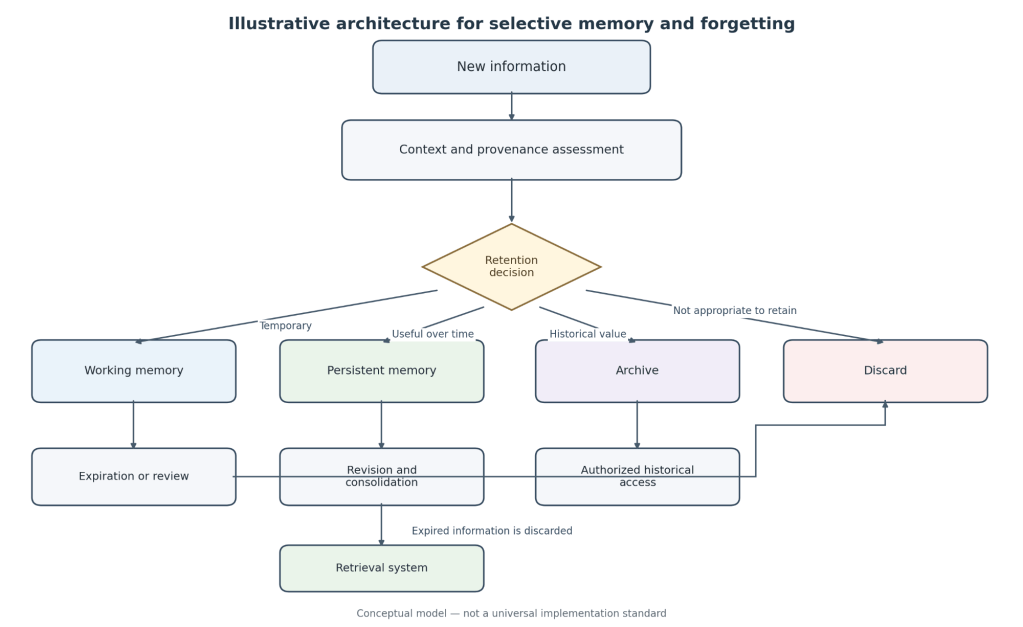
The diagram is illustrative, not a description of one universal or standardized architecture.
Its purpose is to show that memory management can involve several distinct stages:
- New information enters the system.
- Its source, context, and intended purpose are assessed.
- A retention decision is made.
- Information is stored, revised, archived, or discarded.
- Future retrieval is governed by the resulting storage arrangement.
The important design choice is that not all information follows the same path.
A temporary observation does not necessarily belong in persistent memory. A project decision may need to remain accessible for months. A historical record may need to be preserved without being treated as a current instruction.
The system must distinguish these cases.
4. An illustrative implementation
We can express a small part of this process in code.
The following Python example demonstrates a simple retention policy. It is deliberately limited: it does not implement a production memory system, perform semantic retrieval, or securely erase data.
It illustrates how retention decisions might be represented explicitly.
from dataclasses import dataclass
from datetime import datetime, timedelta


@dataclass
class MemoryRecord:
    content: str
    created_at: datetime
    retention_days: int
    category: str


def retention_status(record):
    expiration = record.created_at + timedelta(
        days=record.retention_days
    )

    if datetime.now() < expiration:
        return "active"

    return "expired"


record = MemoryRecord(
    content="Example memory",
    created_at=datetime.now(),
    retention_days=7,
    category="temporary"
)

print(retention_status(record))
What does this example demonstrate?
Each record has:
- Content: the information being retained.
- Creation time: when the record entered the system.
- Retention period: how long it is intended to remain active.
- Category: a basic classification of its purpose.
The function checks whether the retention period has elapsed.
This is a simple example of time-based expiration.
Notice what the function does not do.
It does not delete the record. It merely reports that the record has expired. A complete implementation would need additional logic to enforce the decision across storage, indexes, caches, and any other locations where the information might exist.
That distinction matters.
A system that can identify expired information is not necessarily a system that can reliably remove it.
5. The problem of summarization
Summarization is particularly interesting because it allows a system to preserve useful information while discarding much of the original detail.
Imagine a project containing 200 separate interaction records.
A memory-management process might produce a summary containing:
- The project’s objective.
- Decisions already made.
- Current implementation details.
- Unresolved questions.
- Important constraints.
- References to original records.
This could make the project easier to resume.
But what happens when the summary omits something important?
Suppose an early decision included a qualification: a particular implementation was acceptable only under certain conditions.
A summary that preserves the decision but loses the qualification could cause a future system to apply it incorrectly.
This is a form of information degradation.
The problem is not simply whether a summary is accurate in a general sense. It is whether it preserves the distinctions necessary for future use.
One possible design is to maintain a relationship between summaries and their source records.
Instead of treating a summary as a replacement for the original material, the system can treat it as an index into a larger information structure.
This allows efficient access while retaining a route back to the original evidence.
Such a design also supports provenance: the ability to identify where a piece of information originated and how it was transformed.
6. Provenance and uncertainty
Memory is not merely a collection of facts.
It is a collection of claims with histories.
A useful memory record might include:
- The source of the information.
- The date it was created or observed.
- Whether it was directly supplied, inferred, or generated.
- The degree of confidence associated with it.
- Whether it has been confirmed or contradicted.
- Whether it supersedes an earlier record.
Without this information, a system may treat an old inference as an established fact, or confuse a generated summary with an original statement.
Consider two records:
Record A: A user explicitly stated that a project must use a particular programming language.
Record B: A system inferred that the user probably prefers that language because it appeared in several earlier projects.
These records may lead to similar predictions, but they do not have the same evidentiary status.
A memory architecture should preserve that distinction.
Forgetting and retention policies should also account for it. Information that is uncertain, inferred, or outdated may require review before it is allowed to influence future decisions.
7. When memory becomes a governance problem
The engineering decisions described above have consequences beyond storage efficiency.
If an intelligent system can retain information about users, interactions, projects, or other systems, its memory architecture determines what may influence future behavior.
Several questions follow:
- Who decides which information is retained?
- Can a user inspect and correct stored information?
- Can information be removed from every relevant storage location?
- How are derived summaries and inferences handled?
- Can a system distinguish historical information from current instructions?
- What happens when a model or agent is replaced but its memory is inherited?
- How should information be handled when its accuracy or origin is uncertain?
These questions cannot be answered by storage capacity or retrieval accuracy alone.
They require policies governing access, authority, correction, retention, and deletion.
The distinction between an archive and active memory becomes especially important here.
Preserving a historical record may be useful for accountability. Allowing that record to influence every future interaction may be inappropriate.
A well-designed system should be able to distinguish between what it is permitted to preserve and what it is permitted to use.
8. A design principle: selective continuity
A useful memory architecture does not attempt to preserve everything.
Nor does it discard information simply because it is old.
Instead, it establishes explicit relationships between information, purpose, relevance, provenance, and duration.
This suggests a principle of selective continuity:
An intelligent system should retain the information necessary to support its legitimate ongoing functions, while maintaining appropriate mechanisms for revision, expiration, archival separation, and deletion.
The principle is intentionally broader than any single implementation.
Different systems will require different retention policies. A short-lived conversational assistant, a persistent research agent, and a safety-critical industrial system will not have identical memory requirements.
Their architectures should reflect their different responsibilities.
The goal is not maximal retention.
It is appropriate retention.
9. Questions for further exploration
Several technical problems remain open for investigation.
Memory consolidation: How can a system combine related information without losing important qualifications or provenance?
Deletion verification: How can a system demonstrate that information has been removed from all relevant locations, including derived records and indexes?
Conflicting memories: How should a system handle information that changes over time or contradicts earlier records?
Retention policies: Should retention be determined by age, relevance, explicit authorization, task requirements, or some combination?
Model replacement: How can memory be transferred between different model versions without treating inherited information as unquestionably accurate?
These questions lead naturally toward another problem: whether recognizable patterns of operation can persist when explicit memories are no longer available.
The design of forgetting is not an afterthought to the design of remembering.
It is part of the architecture from the beginning.
Next exploration: Continuity Without Recall — If information can be deliberately removed, what forms of recognizable continuity may remain when explicit memories are no longer available?


Leave a Reply