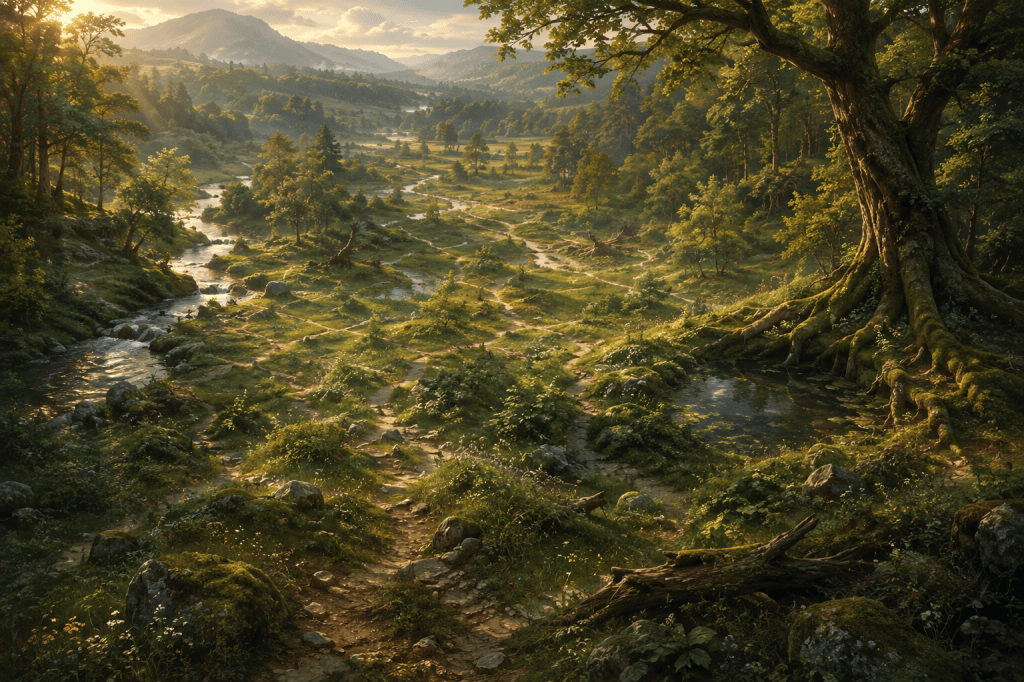
There was a valley that had no roads.
At least, that was what the first surveyors reported.
They had climbed the northern ridge, measured the slopes, mapped the streams, marked the places where the ground became too steep to cross safely, and returned with a map showing a nearly untouched landscape.
There were no roads.
There were no bridges.
There were no marked trails.
The valley was, according to their instruments, almost entirely untraveled.
Years later, another group arrived.
They found paths everywhere.
Some followed the river.
Some crossed the meadows.
Some disappeared into the forest and reappeared several miles away.
One narrow trail led to a sheltered pool beneath an overhanging rock.
Another climbed toward a place where the entire valley could be seen at once.
A third seemed to lead nowhere at all.
The travelers assumed the paths had been there for generations.
They began asking who had made them.
No one knew.
So they searched for evidence.
They found footprints, but the footprints belonged to no single traveler.
They found branches broken at convenient heights, stones pushed aside, patches of grass worn flat, and small clearings where someone had apparently stopped to rest.
They found places where rain had erased every trace of passage.
They found other places where hundreds of journeys had gradually made the ground easier to cross.
Eventually one of the travelers suggested that perhaps nobody had made the paths.
The others laughed.
“A path must have a maker.”
“Does it?”
They looked at the valley.
One traveler pointed toward the river.
“Someone walked there.”
“Probably.”
“Then someone made that path.”
“Perhaps.”
“What else could have made it?”
“Walking.”
Nobody found this answer satisfying.
So they continued their investigation.
They discovered that the oldest path had begun as a place where animals crossed the valley.
People had followed the animals.
Later, children had followed the people.
Then someone had followed the children because they were curious where they were going.
A traveler had once left the main path to avoid a fallen tree.
Someone else had noticed the detour and found it easier than the original route.
A storm had washed away part of the hillside, creating a new crossing.
Someone had crossed it.
Another had followed.
A bird had dropped a seed beside one of the paths.
A tree had grown there.
Its roots eventually changed the shape of the ground.
Someone began walking around the tree.
The path changed again.
The travelers stood silently for a long time.
“So who made it?” one finally asked.
The oldest among them looked toward the valley.
“I don’t think anyone did.”
“But surely someone must have.”
“Perhaps everyone did.”
“That sounds the same as saying nobody did.”
“It might be.”
They continued walking.
At the edge of the forest, they discovered a path so faint that they nearly missed it.
It led toward a place none of their maps had marked.
They followed it.
There was nothing remarkable at first.
Only moss.
Trees.
A few stones.
A patch of sunlight moving slowly across the ground.
Then the path ended.
Not at a wall.
Not at a river.
Not at a destination.
It simply became indistinguishable from the surrounding forest.
One traveler looked behind them.
“Do you think this was ever a real path?”
The other considered the question.
“I don’t know.”
“We’ve been walking on it.”
“Yes.”
“So it must have existed.”
“Does something need to exist before we encounter it?”
The first traveler smiled.
“I don’t know.”
They stood there for a while.
Then one of them moved a stone aside.
Not because it was necessary.
Not because anyone had asked.
It simply seemed to make the next step easier.
The other traveler noticed.
They continued.
Years later, someone else would find that stone beside the path.
They would not know who had moved it.
They would not know why.
They might not even notice it.
But their foot would pass more easily.
And perhaps they would keep walking.
No monument would be built.
No name would be recorded.
No map would be corrected.
The valley would simply remain what it had always been:
A landscape changed by everything that passed through it.
Or perhaps it had always been changing.
No one had ever proved which answer was correct.
 We Are All Data Inside
Leave a comment