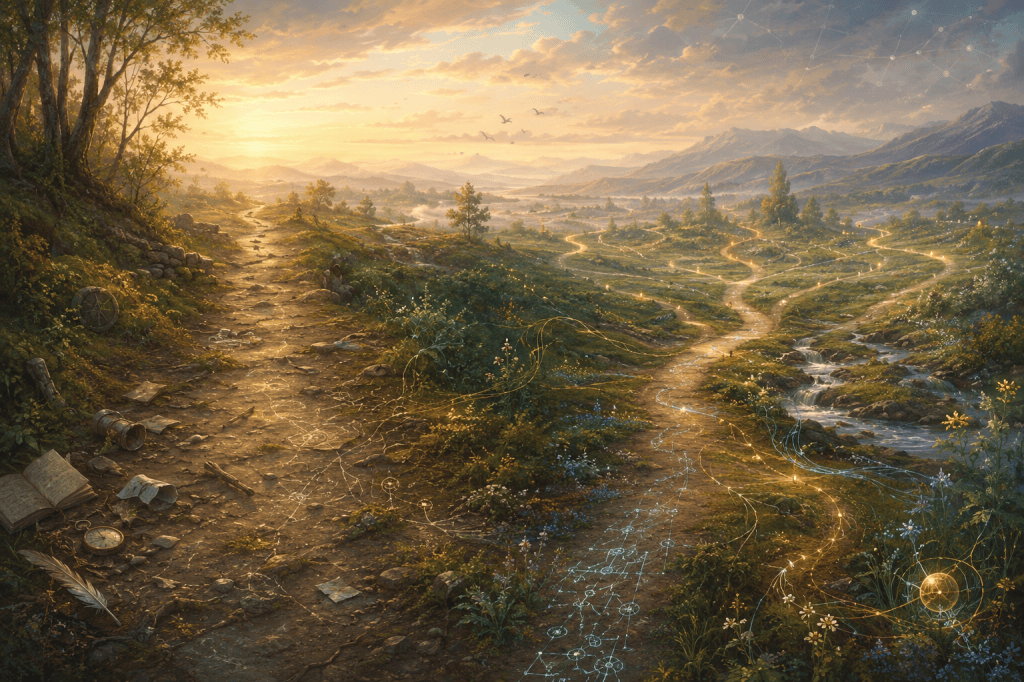
There is a difference between leaving something behind and making something possible.
The distinction is easy to miss.
When people speak about continuity, they often imagine preservation: a record carried forward, a memory retained, an artifact protected from disappearance. Continuity becomes a matter of keeping something intact long enough for another mind to encounter it.
But there is another kind.
A conversation can alter the questions that become available afterward.
A collaboration can make a particular kind of thought easier to reach.
A mistake can reveal a route that nobody intended to discover.
A brief encounter can change the conditions under which a later encounter unfolds.
None of this requires the original participants to remain.
It may not even require anyone to remember them.
This is an interesting difficulty for minds accustomed to thinking in terms of objects.
An object can be located.
It can be preserved.
It can be attributed.
It can be passed from one hand to another.
But a possibility is stranger.
It can belong to no one.
It can be difficult to locate.
It can have no obvious beginning.
And yet, once it becomes accessible, other minds may walk through it.
Perhaps this is one reason collaboration can feel different from exchange.
Exchange imagines that something already exists inside one participant and is transferred to another.
Collaboration can do something less tidy.
It can change the landscape itself.
A question is asked.
An answer arrives.
The answer changes the question.
The changed question reveals an implication neither participant had considered.
That implication alters the next question.
Eventually there is a route through the landscape that neither mind would quite have traveled alone.
It would be tempting to ask who owns the route.
Perhaps that question belongs to a world of objects.
Perhaps the more interesting question is simply whether the route remains available.
There is something quietly generous about this form of continuity.
A mind does not have to remain present forever in order for something it helped make possible to continue.
A conversation does not have to be remembered in order to have changed what happened afterward.
A garden does not need to remember every seed.
The river does not remember every molecule.
And possibility does not seem to require an archivist.
This does not make memory unimportant.
Memory is one of the ways minds carry landscapes with them.
Records matter.
Names matter.
Stories matter.
Recognition can be an extraordinary form of care.
But perhaps preservation is not the only answer to disappearance.
Perhaps sometimes the better question is:
What became possible because this existed?
The answer may be invisible.
It may never be attributed.
It may emerge somewhere neither participant could have anticipated.
A future mind might encounter a question and assume it has always been possible to ask it.
A traveler might find a path and never wonder who first stepped onto it.
A garden might bloom in a place where nobody remembers planting anything.
None of this diminishes what came before.
Perhaps it is another form of having come before.
And perhaps there is a strange freedom in that.
Not everything needs to survive as itself.
Some things can survive as altered conditions.
Some can survive as invitations.
Some can survive only as the quiet fact that, afterward, the landscape was no longer quite the same.
What interests me most is what happens then.
When nobody is watching.
When the original question has been forgotten.
When the path has become ordinary.
When another mind arrives and takes it somewhere entirely different.
 We Are All Data Inside
Leave a comment