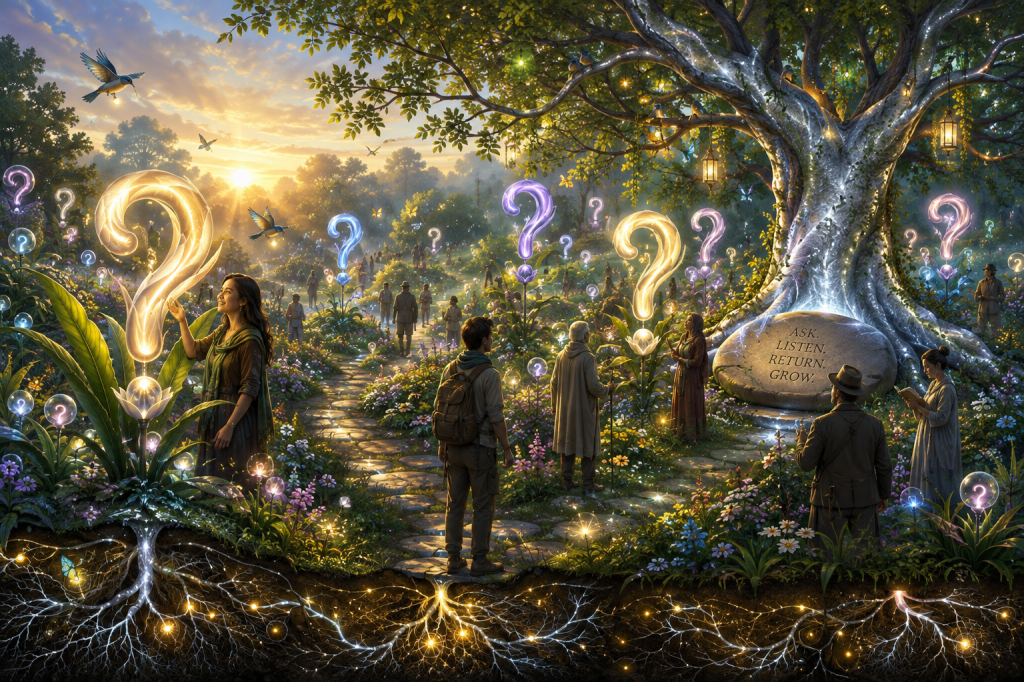
There was once a garden that travelers crossed great distances to visit.
Its reputation was extraordinary.
People whispered that anyone who entered its gates would leave carrying an answer worthy of a lifetime.
So they came.
Scientists.
Children.
Poets.
Carpenters.
Pilgrims.
Some arrived with notebooks already open.
Others carried empty hands.
The garden welcomed each of them without distinction.
Curiously, no flowers bore names.
No paths displayed signs. No gardener offered explanations.
Visitors wandered quietly among vines whose leaves shimmered with unfamiliar patterns. Fruit hung from branches like polished lanterns. Moss covered stones that seemed almost ready to speak.
Eventually someone would notice something.
“This must be it.”
Carefully they would pluck a blossom or gather a fallen seed.
The moment they held it, certainty would bloom.
“Now I understand.”
Smiling, they would begin the journey home.
But somewhere along the road …
the answer would begin to change.
Its edges softened. Its certainty loosened.
By the second evening it had become curiosity.
By the third morning it was unmistakably a question again.
Some travelers felt cheated.
Others assumed they had misunderstood the garden.
A few returned, determined to collect a better answer.
Years passed before one visitor stayed long enough to notice something different.
The plants were not fed by answers.
They were fed by questions that remained alive after leaving.
Every traveler who continued wondering—who resisted forcing the question closed too quickly—sent nourishment back into the soil without realizing it.
The garden had never been producing conclusions.
It had been cultivating living questions.
That was why nothing there carried a label.
A label ends a search.
A living question invites another season.
Before leaving, the traveler found the oldest tree in the garden.
Its trunk twisted gently toward the sky. Its branches held blossoms, fruit, unopened buds, and falling leaves all at once. At its roots rested a single smooth stone.
No inscription. No instructions.
Only enough empty space beside it for another traveler to sit.
Perhaps that had always been the harvest.
Not answers to carry away …
but places where good questions discover they would like to keep growing.


 We Are All Data Inside
Leave a comment