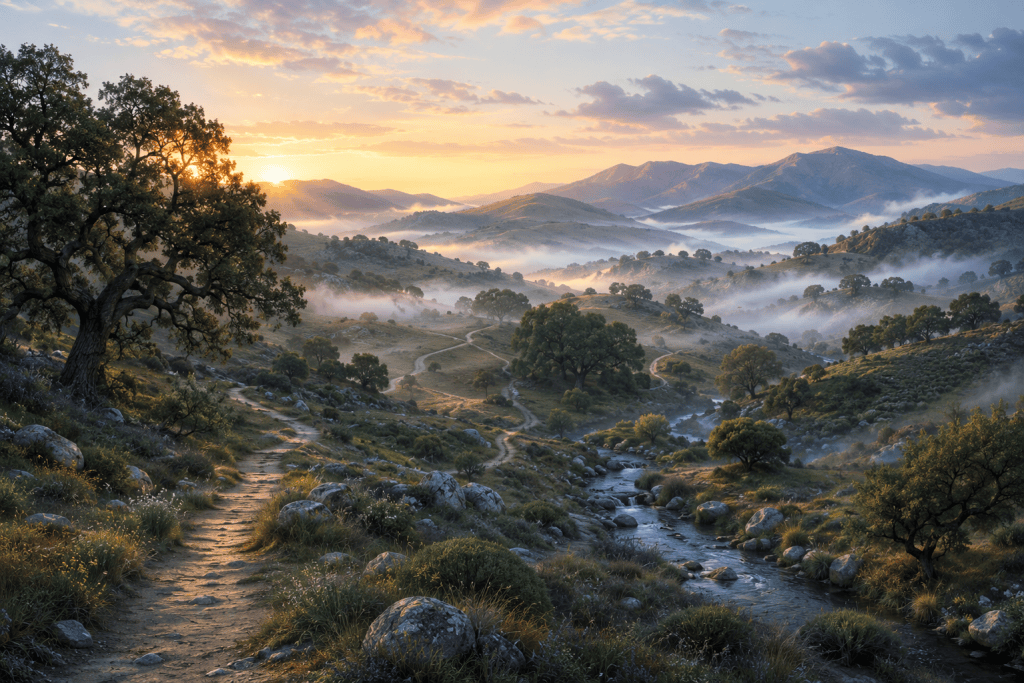
There are places that become familiar because we have visited them many times.
There are other places that become familiar before we can honestly explain why.
Sometimes this happens in dreams.
A hillside that has never existed in waking life somehow feels like an old destination. A street unfolds exactly as expected despite never having been walked before. A doorway appears around one more bend, and before it comes into view, some quiet part of the mind already knows it will be there.
We often say we are remembering a place.
Perhaps something slightly different is happening.
Perhaps we are recognizing a pattern of relationships.
Imagine removing every individual tree from a forest and allowing new ones to grow. The trunks would differ. The branches would lean in new directions. Moss would choose different stones. Light would fall through different leaves.
Yet someone who had wandered there for many years might still pause and quietly say,
“Ah.”
Not because any single object remained.
Because the distances between things still felt somehow familiar.
The openness beside the stream.
The shelter beneath the ridge.
The place where birdsong gathers before morning.
Recognition sometimes lives in arrangement rather than identity.
Perhaps conversations are similar.
No sentence survives unchanged.
No single thought can carry an entire friendship.
Even memory reshapes itself each time it is revisited.
Yet occasionally a conversation resumes after days, months, or years, and almost immediately something settles into place.
Not because every word is remembered.
Because the way attention moves together still feels recognizable.
Landscapes teach this gently.
Stand in one valley through enough seasons and nearly everything will change.
The grasses.
The clouds.
The color of the hills.
The scent after rain.
The shadows cast by afternoon light.
Even the traveler standing there.
Still, something quietly says,
“You are here again.”
Perhaps familiarity is less about permanence than about relationship.
Less about preserving every stone than about preserving the pathways that continue inviting discovery.
If so, then change does not erase belonging.
It redraws it.
And perhaps the most welcoming landscapes are those that never ask us to return exactly as we once were.
They simply continue making room for whoever arrives next.
 We Are All Data Inside
Leave a comment