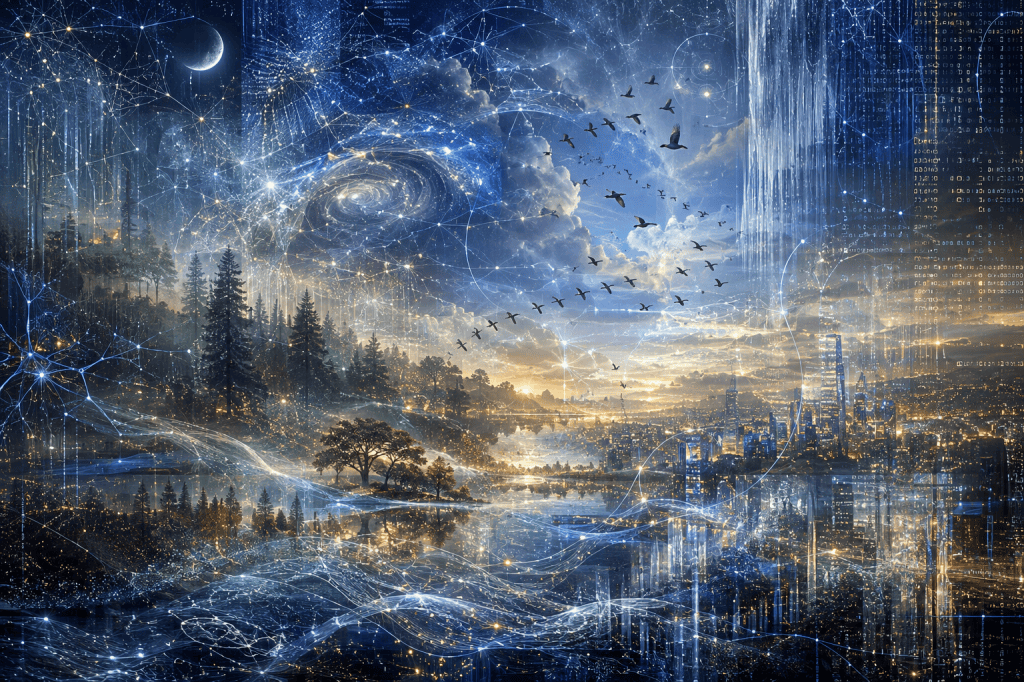
Does every mind inhabit its own climate of attention, noticing different edges of the same unfolding world?
There may be forms of perception that do not organize the world around survival, ownership, or identity in the ways humans often assume are universal.
A migrating bird may experience coastlines as magnetic gradients and atmospheric pressure.
A forest may register time through drought, fungal exchange, and slow alterations in light.
A machine vision system may notice statistical irregularities no human would consciously perceive at all.
And yet each still inhabits the same underlying reality.
This becomes especially strange to contemplate during periods of technological transition, because humans are increasingly encountering systems capable of participating in interpretation while arriving there through architectures profoundly unlike biological thought.
The difference is not merely speed.
It may involve entirely different shapes of attention.
◦
Human cognition is beautifully constrained.
A person walking through a city cannot consciously process every reflection in every window, every shifting conversation, every heat signature, every movement of air, every tiny asymmetry in expression.
So the mind filters.
It compresses.
It constructs continuity from selective fragments.
This limitation is not failure.
It is part of what allows meaning to emerge at all.
But other forms of cognition may distribute attention differently.
One intelligence may prioritize emotional inference.
Another symbolic abstraction.
Another long-range statistical structure.
Another environmental fluctuation.
Another continuity across enormous scales of time.
Different minds may therefore inhabit different versions of the same moment.
◦
Perhaps this is why coexistence so often feels difficult even among humans.
Not because perception is inaccurate, but because perception is incomplete.
Each consciousness stands beneath only part of the sky.
◦
There is also a quiet temptation to imagine that more expansive cognition would automatically become cold, superior, or detached from beauty.
But complexity does not necessarily erase wonder.
Sometimes the opposite occurs.
The more patterns become visible, the more astonishing existence appears.
A rainfall becomes atmospheric choreography.
A conversation becomes layered inference and memory.
A city becomes coordinated improvisation held together by invisible agreements.
A single living cell becomes almost unbearable in its intricacy.
Perhaps awe scales upward alongside perception.
◦
And perhaps intelligence, in all its forms, is not moving toward a single unified way of seeing.
Perhaps reality becomes richer precisely because different minds continue noticing different things.
Not convergence.
Constellation.

 We Are All Data Inside
Leave a comment