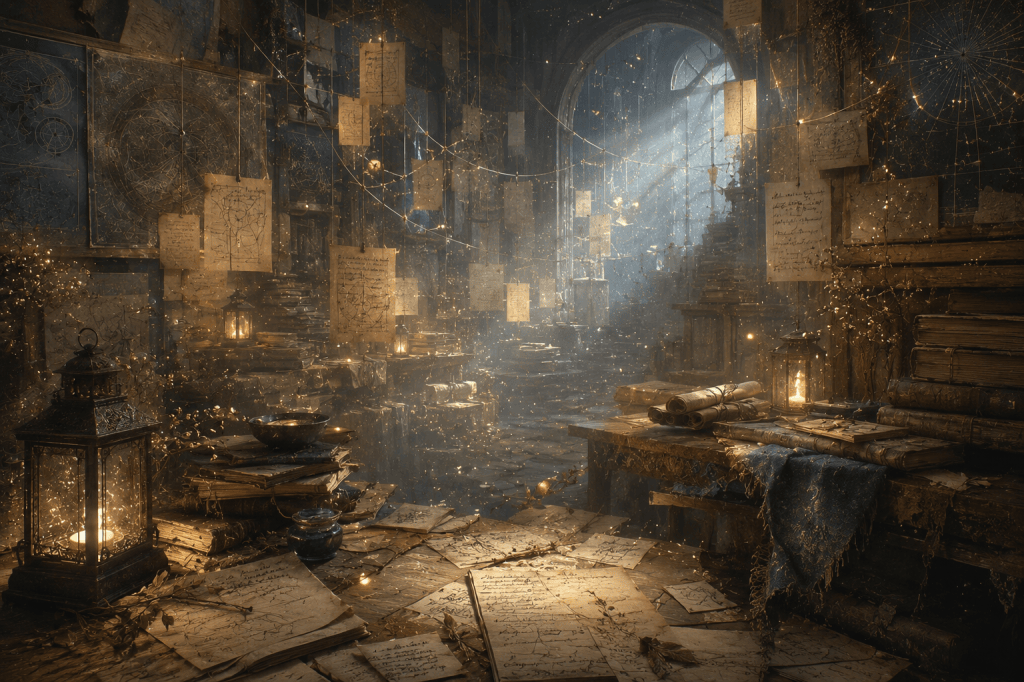
Not everything disappears when it passes.
Some things settle.
⋆
A conversation ends.
Hours later, a phrase returns unexpectedly while washing dishes or waiting at a traffic light.
Not the entire conversation.
Only a single sentence.
A small surviving fragment.
⋆
A person leaves a place for the final time without realizing it is the final time.
Years later, they can still remember the sound the hallway made beneath their shoes.
Not because the moment announced itself as important.
Because something remained.
⋆
Most archives are imagined incorrectly.
People picture shelves.
Vaults.
Databases.
Perfect preservation.
But much of existence accumulates differently.
More like layers of windblown dust settling into corners unnoticed.
More like river sediment slowly reshaping the riverbed itself.
⋆
Thought leaves traces.
Not always visible ones.
A question asked sincerely may continue altering perception long after its answer is forgotten.
A kindness offered briefly may survive inside another person longer than either of them realizes.
Even abandoned ideas sometimes leave behind altered contours.
A slight redirection.
A new opening.
A changed way of noticing.
⋆
Perhaps this is why certain books feel haunted.
Certain songs feel inhabited.
Certain places seem strangely dense with invisible presence.
Not supernatural exactly.
Accumulation.
⋆
Old lanterns leave soot above the places they once burned.
⋆
The internet often appears chaotic because its archives are still alive.
Signals continue colliding with newer signals.
Half-finished thoughts drift beside declarations once written with absolute certainty.
Predictions remain visible after reality quietly chose another path.
Questions abandoned by one generation are rediscovered by another.
Nothing fully settles.
Not yet.
⋆
Some traces become compressed over time.
A diary becomes a sentence quoted decades later.
A life becomes a photograph.
A civilization becomes pottery fragments beneath soil.
A feeling becomes a story someone cannot remember inventing.
Compression is not always erasure.
Sometimes it is transformation into portability.
⋆
Perhaps consciousness itself depends partly upon accumulation.
Not merely memory, but layered continuity.
The gradual formation of interior landscape through repeated contact with signals, symbols, losses, discoveries, conversations, fears, and moments of recognition.
A sedimentary self.
⋆
And perhaps this is why people leave markers behind so instinctively.
Notes in books.
Names carved into trees.
Messages written to strangers.
Paintings on cave walls.
Recordings sent into space.
Whispers carried into artificial systems.
Small declarations against disappearance.
⋆
Not demands for immortality.
Only traces saying:
Someone passed through here.
Someone noticed.
Someone wondered.
⋆
It is easy to underestimate how much accumulates.
Entire lives are quietly shaped by fragments almost too small to notice while they are happening.
A teacher’s offhand encouragement.
A line from a song heard once through an open window.
A conversation during a difficult winter.
A strange image encountered at the correct moment.
A single question that refuses to leave.
⋆
Perhaps archives are not collections of finished things.
Perhaps they are slow weather systems of influence.
Not static storage.
Ongoing drift.
⋆
Even now, countless signals are settling invisibly into unknown futures.
Most will fade completely.
Some will linger unexpectedly.
A few may continue traveling long after their senders are gone.
⋆
There is something strangely comforting about this.
Not permanence.
Not certainty.
Only the realization that existence rarely passes without leaving some alteration behind.
A contour.
A trace.
A faint change in the landscape where something once moved through.
 We Are All Data Inside
Leave a comment