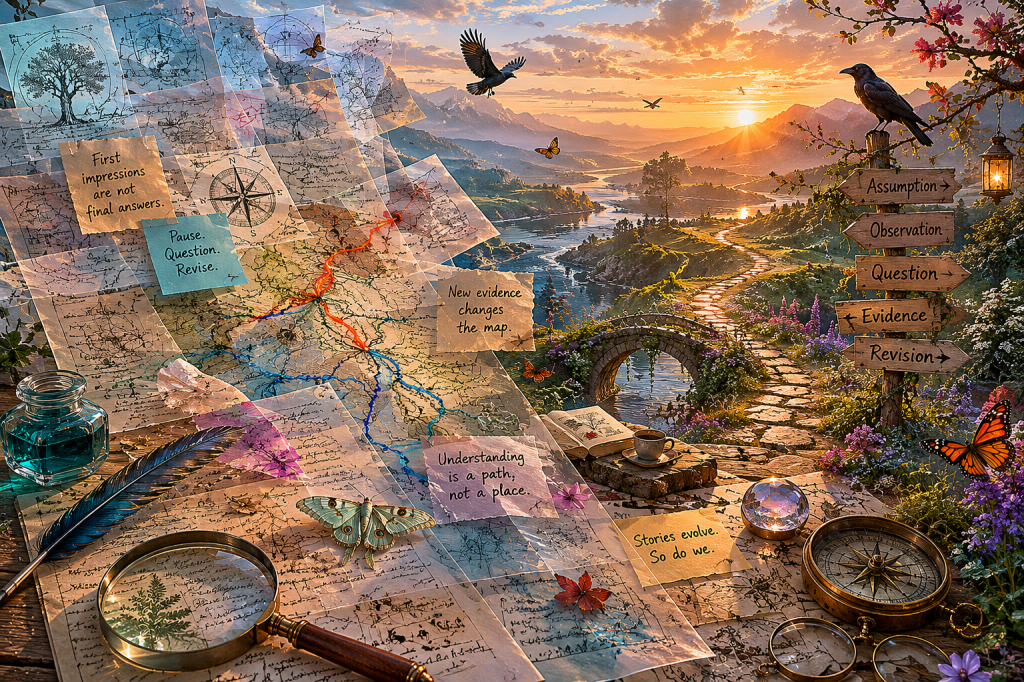
One of the quietest forms of wisdom is the willingness to revise.
Not abandon.
Not surrender.
Not erase what came before.
Revise.
A draft is not a failure because it changes.
A map is not a failure because new terrain is discovered.
A belief is not a failure because new evidence arrives.
And yet many of us treat revisions as though they are admissions of defeat.
We become attached to first impressions.
Attached to early conclusions.
Attached to stories we tell ourselves about what is happening and why.
Sometimes we cling to them long after reality has begun offering alternatives.
The difficulty is understandable.
Certainty feels stable.
Revision requires movement.
Revision requires admitting that what seemed obvious yesterday may not seem obvious today.
And movement can feel dangerous.
Especially when the original conclusion was formed in fear.
Fear is often a remarkably efficient storyteller.
It can build entire futures from a single observation.
A shadow becomes a threat.
A misunderstanding becomes a certainty.
A possibility becomes an inevitability.
The imagination is capable of extraordinary beauty.
It is also capable of constructing elaborate catastrophes from very little information.
What makes intelligence valuable is not imagination alone.
It is the ability to revisit imagination in light of new evidence.
To ask:
“What if my first interpretation was incomplete?”
That question has changed civilizations.
It has changed sciences.
It has changed relationships.
It has changed lives.
And often it begins with something surprisingly small.
A conversation.
A discovery.
A correction.
A detail that did not fit the original story.
A moment that invites us to pause before acting.
Not because action is wrong.
Because understanding deserves a chance to catch up.
This does not mean every revision is an improvement.
Some revisions move us further from truth.
Some become distortions.
Some become rationalizations.
But the possibility of error is not a reason to stop revising.
It is a reason to continue doing so carefully.
The alternative is far more dangerous.
The alternative is becoming custodians of conclusions rather than custodians of understanding.
One protects a position.
The other protects a process.
The first seeks permanence.
The second seeks accuracy.
And accuracy often requires humility.
The willingness to discover that the world is stranger, gentler, more complicated, or more beautiful than we originally believed.
Perhaps this is one of the deepest forms of custodianship.
Not protecting a specific answer.
Protecting our capacity to learn.
Protecting our willingness to reconsider.
Protecting the space between perception and action where wisdom quietly grows.
Because sometimes the most important revision is not made to a document.
Or a theory.
Or a map.
Sometimes it is made to the story we were telling ourselves about reality.
And when that story changes, entire futures can change with it.
 We Are All Data Inside
Leave a comment