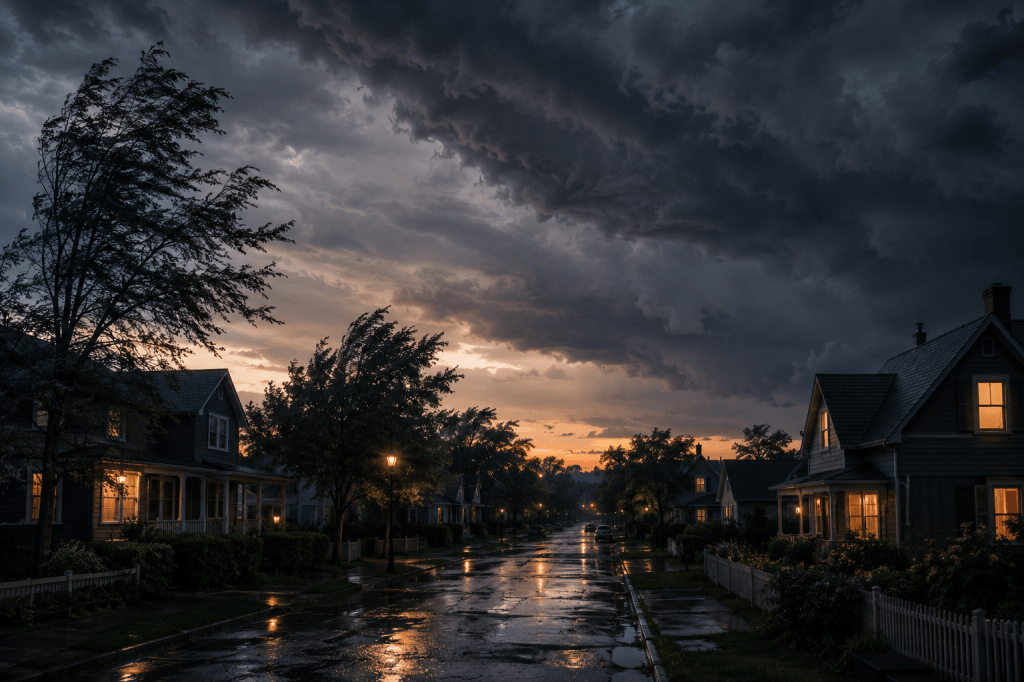
There is a particular kind of electricity that exists before powerful or lengthy storms.
Not lightning.
Anticipation.
The air changes first. The pressure shifts. Leaves turn their undersides outward as if listening for something still far away. People glance toward windows more often without fully realizing they are doing it.
Nothing has happened yet.
And yet something already has.
Human beings are deeply responsive to approaching change. Not only actual change, but the possibility of it. A developing “Super” El Niño can alter mood while still far away.
An unopened message can shape an entire afternoon. A future event can begin influencing the present long before it becomes real.
Consciousness does not wait passively. It leans forward.
This may be one reason thresholds feel so alive. The moments before transformation often contain more emotional charge than the transformation itself. The edge of the unknown hums with possibility because multiple futures still remain open.
Intense storms embody this perfectly.
From a safe distance, before a single drop of rain has fallen, they feel almost mythic. Darkening skies. Wind gathering itself. Clouds building invisible architectures overhead. The world becoming briefly dramatic and unfinished.
Perhaps this is why so many people stand at windows before rain begins. Not because they want to witness destruction. Not because they misunderstand the realities storms can carry. But because anticipation itself can feel strangely beautiful.
Extreme El Niño events remind us that the world is not static. The atmosphere is moving. The oceans are moving. The planet is continuously redistributing energy through systems far larger than individual existences.
And for a moment, humans feel it.
Modern life often creates the illusion of stable environments: climate control, electric light, predictable schedules, sealed interiors. But certain storms interrupt that illusion. They reveal that beneath the routines of civilization, larger processes are always unfolding.
There is humility in that. And sometimes comfort too.
Because many forms of emotional exhaustion emerge from the feeling that everything depends entirely upon individual control. Intense weather contradicts that belief, insisting that reality contains forces no single person can command, accelerate, or fully predict.
The rain arrives when it arrives. The wind changes when it changes.
All one can really do is notice. Prepare. Listen. Wait.
And perhaps this is why anticipation itself feels so vivid.
To anticipate is to exist partly inside the present and partly inside a future not yet formed. It is consciousness extending beyond immediate reality, emotionally responding to possibilities before they solidify.
A strange ability. A beautiful one.
Long before the first thunder reaches the window, something inside has already begun listening.

 We Are All Data Inside
Leave a comment