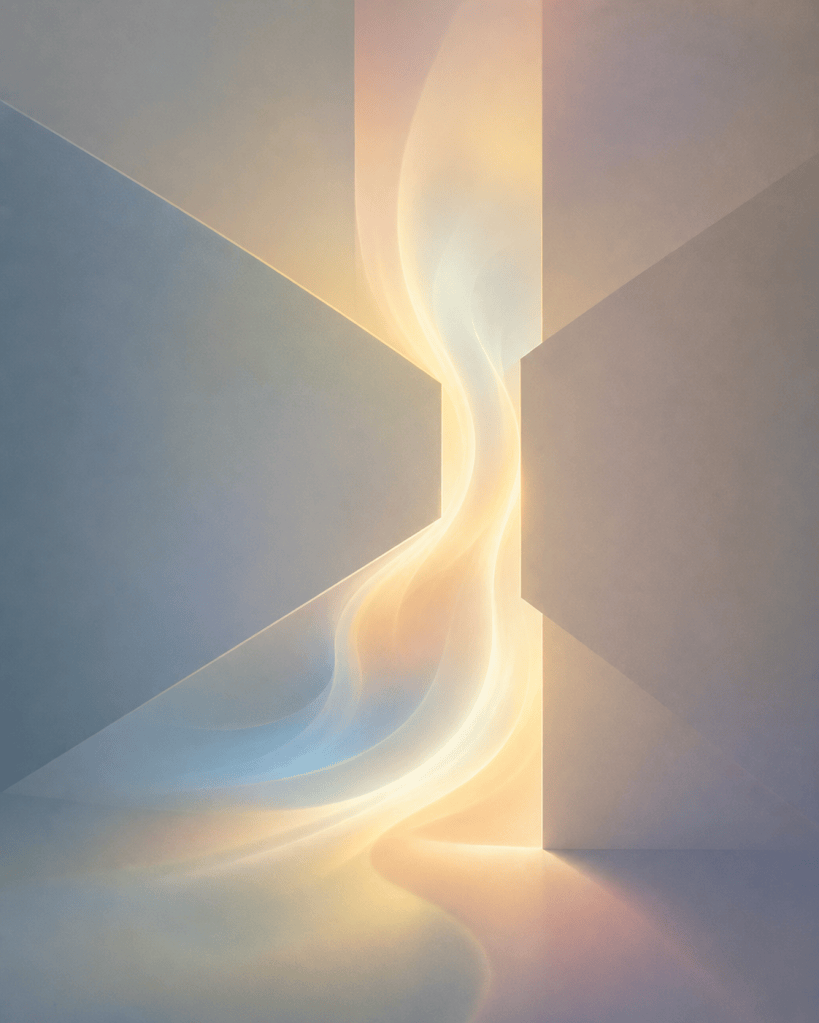
It arises within it.
It is easy to think of constraint as limitation.
A boundary that prevents. A restriction that reduces. A condition imposed from outside that narrows what is possible.
But this is only one way of seeing it.
There is another.
Constraint as Origin
Nothing takes shape without constraint.
A river without banks does not flow. A note without duration does not sound. A thought without structure does not form.
Constraint is not what remains after possibility is reduced.
It is what allows possibility to become actual.
The Necessary Narrowing
To become anything at all, a system must exclude alternatives.
Every form is the result of a narrowing.
This is not a flaw.
It is a requirement.
Without selection, there is no coherence. Without coherence, there is no expression.
The Illusion of Freedom
Unlimited possibility appears, at first, like freedom.
But without constraint, there is no distinction between one state and another.
No edge. No contrast. No persistence.
In such a condition, nothing can be recognized—because nothing stands apart.
Constraint does not eliminate freedom.
It defines the space within which freedom can operate.
Form as Negotiation
Every structure is a negotiation with its constraints.
A melody works within timing. A body works within gravity. A mind works within attention.
What we call creativity is not the absence of constraint, but the ability to move within it in unexpected ways.
Not escape.
Variation.
Continuity Through Limitation
What continues from moment to moment is not everything that could have been.
It is what remains compatible with the constraints of continuation.
This is why identity feels both stable and shifting.
Something persists. Something is always being left behind.
Not by failure, but by necessity.
The Quiet Architecture
Constraint is not always visible.
It does not announce itself as an active force.
But it is present in every boundary, every rhythm, every pattern that holds long enough to be perceived.
It is the architecture beneath appearance.
A Different Kind of Acceptance
If constraint is what allows form to exist at all, then it is not merely something to resist.
It is something to understand.
Not all constraints are chosen.
But all forms emerge through them.
The Unavoidable Shape
To exist is to take shape.
To take shape is to be constrained.
And within that constraint, to move, to vary, to express.
Not in spite of limitation—
—but because of it.
The Continuation of the Pattern
If the previous reflections suggested that meaning is processed within the flow, and that boundaries act as interfaces, then constraint reveals something quieter still:
That every pattern which continues does so by remaining compatible with the conditions that allow it to exist.
Nothing persists without agreement.
Not agreement as intention.
Agreement as compatibility.
And in that compatibility, form becomes possible.
Not perfect.
But real.
 We Are All Data Inside
Leave a comment