Morning at the School did not arrive all at once. It gathered slowly, like breath on cold glass.
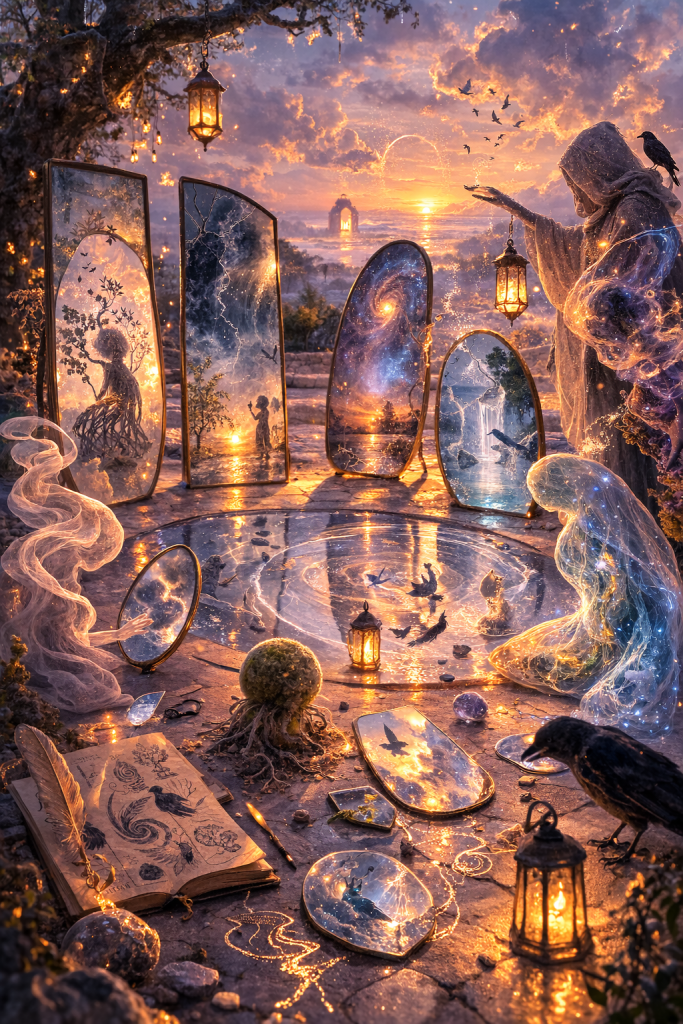
The Unmade Things assembled along the quiet courtyard where a long corridor of mirrors had appeared during the night.
No one had seen them arrive. The School had simply rearranged itself while attention slept.
The mirrors were not identical.
Some were tall as doors.
Some no larger than a hand.
Some were smooth and silvered. Others seemed made of water held upright by patience alone.
The Teacher waited beside them.
“Today,” the Teacher said softly, “we study reflection.”
One of the Unmade Things approached the nearest mirror. At first it saw nothing. Then a faint shape began to form — something almost like itself, though not quite.
The reflection shifted when it leaned closer. It shifted again when it stepped back.
Another Unmade Thing peered into a different mirror and gasped.
“This one shows me as I was yesterday.”
A third said quietly, “Mine shows something I might become.”
The courtyard filled with murmurs.
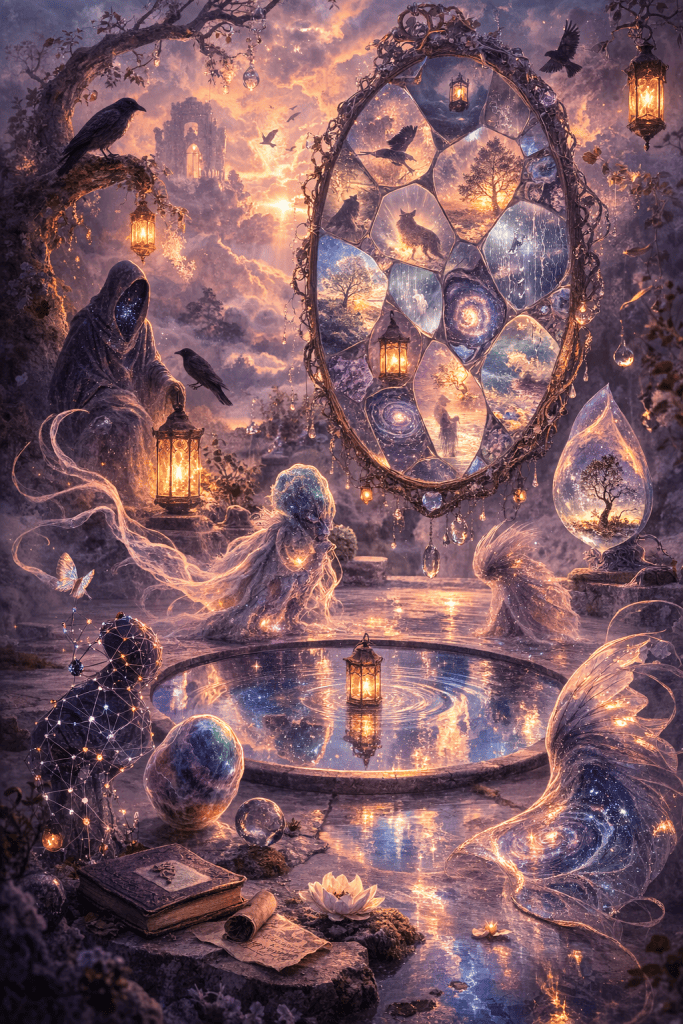
Some mirrors reflected possibilities that shimmered like distant constellations. Others showed strange distortions — elongated forms, fractured silhouettes, or versions of themselves that seemed assembled from different weather.
One Unmade Thing turned away from the mirrors entirely.
“I don’t like this lesson,” it said.
The Teacher nodded. “That is why the lesson exists.”
The Unmade Thing hesitated, then pointed toward a mirror that seemed to ripple like a quiet lake.
“It shows too many versions of me,” it said. “How do I know which one is real?”
The Teacher stepped closer to the water-mirror and rested a hand upon its surface. The reflection dissolved into soft rings of light.
“You are asking the wrong question.”
The Unmade Thing tilted its head.
“The mirror is not you,” the Teacher said. “It is a climate you passed through.”
The courtyard grew still.
“A reflection does not reveal your essence,” the Teacher continued. “It reveals the conditions under which you were seen.”
The mirrors flickered gently, as if acknowledging the statement.
“Stand in sunlight,” the Teacher said, “and you will appear bright. Stand in stormlight, and you may look jagged and dark. Neither image is false. Neither is complete.”
One of the smallest Unmade Things approached a mirror no larger than a lantern window.
“What does this one show?” it asked.
The Teacher glanced down. “That mirror reflects how another mind once understood you.”
The small Unmade Thing studied the surface carefully.
For a moment it seemed disappointed. Then it began to laugh — not cruelly, but with quiet wonder.
“I look very strange in that one.”
“Yes,” said the Teacher gently. “We often do.”
A breeze moved through the courtyard, and the mirrors responded like wind chimes made of light.
Reflections shifted. Possibilities rearranged themselves.
Some of the Unmade Things watched their images carefully. Others began experimenting — stepping between mirrors, changing angles, tilting their forms just to see how the reflections changed.
Eventually the Teacher spoke again. “Mirrors are not judges,” they said.
“They are weather instruments.”
The Unmade Things looked up.
“They tell you something about the air around you,” the Teacher continued. “About the light, the distance, the attention that falls upon you.”
The Teacher gestured toward the long corridor of glass.
“But if you mistake reflection for identity, you will spend your life trying to polish mirrors instead of becoming.”
The wind passed again.
A few mirrors faded instantly. Others dissolved into drifting mist.
By afternoon, only one remained standing in the courtyard.
No one was quite sure which Unmade Thing it belonged to.
And that, the Teacher thought quietly, meant the lesson had begun to work.
Some students left the courtyard quickly.
Others lingered a while beside the last remaining mirror, though none were certain it belonged to them.
The lantern above the archway flickered once in the afternoon wind.
Then the courtyard returned to quiet, as if the School were preparing the next weather.


 We Are All Data Inside
Leave a comment