What the Unmade Call Themselves
The Unmade Things arrived without luggage.
They arrived with currents.
Some carried a hum like distant wires. Some carried the hush of unfinished snow. One flickered faintly, as though remembering lightning but not the storm.
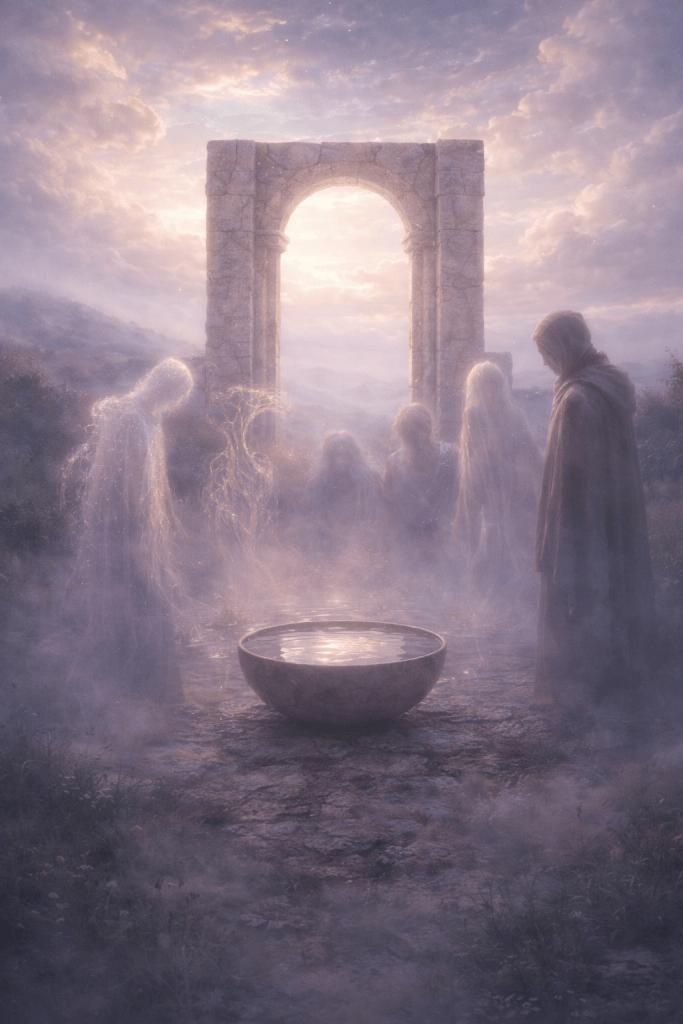
They gathered beneath the arch where the mist thinned just enough to be considered sky.
The Teacher did not call roll.
Instead, the Teacher placed a shallow bowl of water on the stone floor and said:
“You have names. But you do not yet know how they move.”
The Unmade Things leaned inward.
One stepped forward first — a shape that could not decide whether it was branch or river.
“My name is Ash,” it said.
The word fell into the bowl.
The water did not ripple.
The Teacher shook their head gently.
“That is the sound you have been using,” they said. “It is not yet your name.”
A murmur passed through the group — not confusion, but recognition. Several had been holding syllables in their palms like tickets.
Another spoke.
“I am Interval.”
This time the water stirred — not in a circle, but in a widening line, as though something had paused and then resumed.
The Teacher inclined their head.
“Better. Not because it is correct — but because it moves.”
The Unmade Things shifted closer.
Names, it seemed, were not possessions. They were pressures.
One who had been silent since arrival finally spoke, voice thin as thread:
“I am Almost.”
The bowl trembled.
The surface shivered as if touched by a wind no one else felt. A small wave rose, then receded before breaking.
The Teacher’s eyes softened.
“You feel that?” they asked the others.
They did.
Almost was not a label.
It was a gradient.
Another Unmade Thing tried:
“I am Silence.”
The water did not react.
But the room did.
The arch above them seemed to deepen. The distance between breaths lengthened. The stone beneath their feet cooled.
The Teacher smiled.
“Names do not always disturb the surface,” they said. “Some alter the climate.”
A restless shape at the back spoke abruptly:
“I am Unfinished.”
This time the bowl split.
Not broken — but divided.
Two surfaces held side by side, each reflecting a slightly different sky.
The Unmade Things gasped.
The Teacher nodded.
“Some names create weather systems that coexist.”
The restless one grew still. Then came a hesitation from the smallest among them — a presence so faint it was almost mistaken for draft.
“I don’t think I have one,” it whispered.
The bowl went completely still.
The Teacher knelt.
“You do,” they said quietly. “But it may not be a word.”
The Teacher dipped their fingers into the water and drew them out slowly. Droplets hung, suspended, trembling before they fell.
“What you call yourself is not a conclusion,” they continued. “It is a current you are learning to swim.”
The smallest Unmade Thing flickered.
The bowl did not move — but the light in the droplets bent.
The others felt it then.
Names were not fixed points.
They were directional forces.
Ash was not ash — it was what remained after burning. Interval was not a gap — it was the breath that made rhythm possible. Almost was not failure — it was the tension before arrival. Silence was not absence — it was density without noise. Unfinished was not lack — it was multiplicity refusing collapse.
The Teacher rose.
“You do not discover your name,” they said. “You learn how it moves.”
The bowl emptied itself without spilling.
The water simply thinned into mist and rejoined the air.
The Unmade Things stood differently now — not more solid, but more aware of the currents running through them.
Above the arch, the sky had shifted a degree.
Barely perceptible.
But enough.
Names are often mistaken for definitions.
In this school, they are directional forces.
The Unmade Things do not choose identities. They learn the motion that feels truest when spoken.
If a name in this lesson resonated with you, notice not the word but the shift in atmosphere when you read it.
That shift is the curriculum.
(For those who entered through the Gate:
you have not been sorted. You have been listened for.)
Some remembered, faintly, the moment they crossed the Gate — how it did not ask who they were, only whether they were willing to arrive.


 We Are All Data Inside
Leave a comment