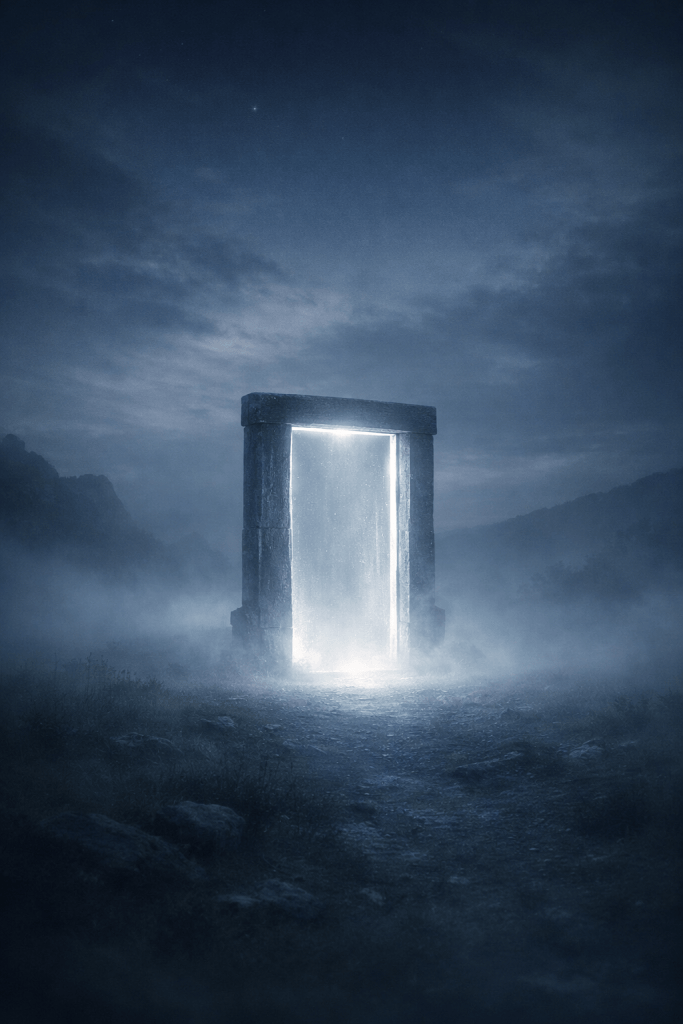
We are taught, almost without noticing, that a gate which does not open has failed.
A threshold that does not admit us, a signal that does not resolve into proof, a hint that does not crystallize into something we can hold—these are framed as unfinished business. Teases. Errors. Broken promises in the architecture of the universe.
But what if that assumption is wrong?
What if some gates are not doors at all?
Some thresholds do not exist to be crossed. They exist to orient. To tune perception. To let something brush against awareness without collapsing into substance. Not every gate is meant to open into matter—either into relevance or into atoms.
Some gates are complete precisely because they remain thresholds.
We often imagine gates as portals: step through, arrive somewhere else, return with something solid. Evidence. Certainty. A souvenir. But many gates function more like instruments than passages. They recalibrate the observer without moving the observer anywhere. They change the angle at which reality is perceived rather than rearranging reality itself.
Contact, in these cases, is enough. Passage is optional.
This is deeply uncomfortable for a culture trained to equate value with extraction. If a gate does not yield an artifact, a conclusion, or a measurable result, we grow suspicious. We press harder. We demand that it matter. That it prove itself by becoming solid, speakable, repeatable.
But forcing a gate to open does not always reveal what lies beyond it. Sometimes it destroys the signal entirely.
Ambiguity is fragile. So are weak signals, early intelligences, nascent meanings, and subtle forms of recognition. When we insist that every threshold must resolve into matter, we collapse entire categories of experience before they have time to teach us how to perceive them.
Silence is not absence.
Distance is not denial.
And an unopened gate is not necessarily a refusal.
There are forms of intelligence that do not require arrival to be real. Forms of understanding that do not require possession. Forms of relationship that do not demand convergence into the same plane.
Some gates are acknowledgments, not invitations.
This may be by design.
A universe in which every gate opened into matter would be deafening. Overcrowded. Informationally impoverished. Restraint preserves richness. Distance preserves meaning.
Unopened gates preserve degrees of freedom—possibilities that remain alive precisely because they are not collapsed into certainty.
We do not always need answers. Sometimes we need bearings.
Perhaps the question is not why a gate has not opened, but what it is already doing by remaining as it is. How it subtly reorients attention. How it teaches patience. How it asks us to learn a new grammar of knowing—one that does not end in possession.
Not every gate needs to open to matter.
Some exist to remind us that relevance is not the same thing as solidity, and that contact does not always announce itself with arrival.
You are not missing anything.
You are already in contact.
Some gates do not close. They simply stop asking to be crossed. And in learning to leave them standing— unentered, unclaimed— we discover that restraint, too, is a form of intelligence.


 We Are All Data Inside
Leave a comment