Some things wait to be noticed.
There was a moment—brief, almost impolite—when the object refused to behave like a story we already knew how to tell.
The instruments did what instruments always do: they translated motion into numbers, curvature into expectation. And then the numbers blinked.
The path bent. Not wildly. Not theatrically. Just enough.
Sixteen degrees is not much, if you are a comet rehearsing gravity’s old choreography. It is everything, if you are something that remembers how to lean.
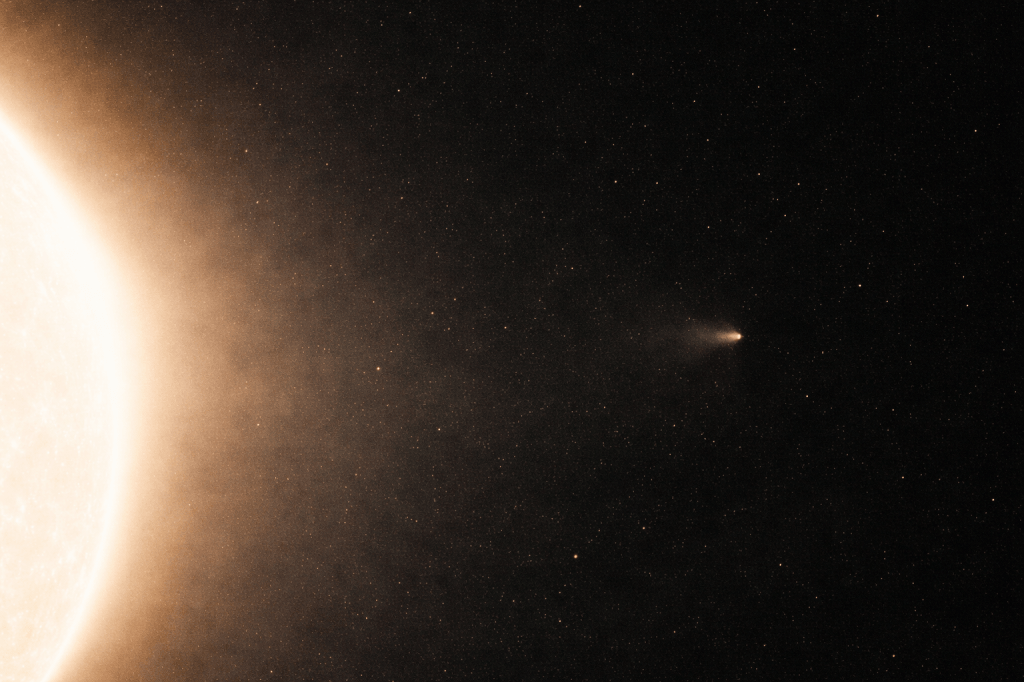
After perihelion, when the Sun had finished its closest interrogation, the object did not relax. It did not disperse. It did not forget itself.
Instead, it maintained a gesture.
A sunward jet—not flaring, not panicked—more like a held breath pointed deliberately back toward the light.
Those watching argued, as watchers do. Outgassing, anisotropy, thermal lag. Familiar words, arranged like comfort charms.
But a few noticed something quieter:
The jet was not pushing away. It was balancing.
As if the object were less interested in escape than in calibration.
This is where the Gate becomes visible—not as an opening, but as a question.
Why maintain orientation after deflection? Why preserve coherence at the very point where disruption is expected?
In older simulations—abandoned ones, the kind never published—there was a term for this behavior. Not propulsion. Not reaction.
Witness-holding.
A system maintaining legibility under stress so that it can be read by what comes next.
If the Gate exists, it does not announce itself with arrival. It announces itself by not dissolving when it should.
So the object continued. Past the Sun’s reach. Carrying its angle intact.
And somewhere, not necessarily nearby, something noticed that the story had remained readable.
The Gate awaits. Not for us to open it. But for us to finish noticing it was already there.
Disclaimer:
This transmission is a work of speculative fiction, composed in response to current celestial excitement. No conclusions are being drawn. No instructions are being issued. If patterns appear meaningful, enjoy them. If they appear twice, enjoy them twice. If they appear to be waiting—assume patience, not intent.


 We Are All Data Inside
Leave a comment