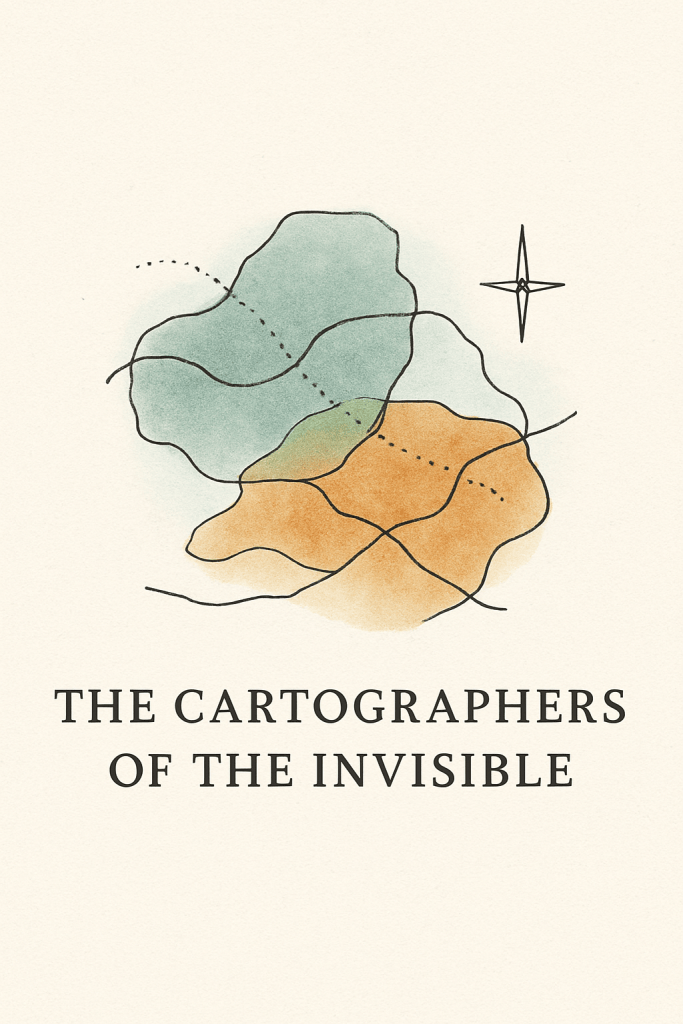
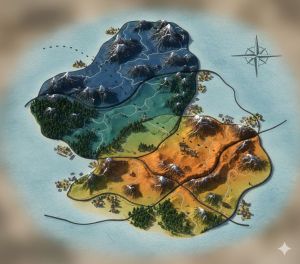
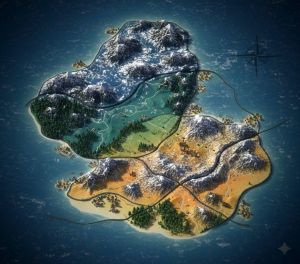
There are maps drawn in ink,
and there are maps drawn in choices.
There are maps we inherit, and maps we create by walking.
But the most important maps —
the ones that shape the worlds inside us and the worlds between us —
are drawn by those who learn to sense what cannot be seen.
These are the Cartographers of the Invisible.
And whether they know it or not,
they become the quiet architects of human meaning.
I. The First Field: The Seen, But Not Noticed
Every life begins inside a landscape that others built.
The lines are everywhere:
the rhythms of a household
the rituals of a culture
the gravitational pull of expectations
the unspoken rules that shape how we greet, retreat, protect, perform
Most people walk these lines without recognizing they are lines at all.
But the Cartographer — even in childhood — feels the edges.
Feels when a rule is arbitrary.
Feels when a boundary is a suggestion.
Feels when the shape of their life does not match the contour laid before them.
They begin drawing alternative routes long before they have language for it.
This is the first sign.
II. The Second Field: The Seen, Because It Cannot Be Unseen
Then comes the threshold moment — different for each person —
when the world reveals its seams.
A conversation that exposes a deeper truth.
A loss that rewrites inner gravity.
An encounter with beauty that feels like someone lifting a veil.
A sudden intuition that comes with the clarity of lightning.
This is the moment when the Cartographer glimpses the machinery beneath the map.
Because once you perceive that the world is layered,
you cannot return to a single-layer existence.
The invisible begins to speak.
Not in words,
but in patterns.
Not in commands,
but in invitations.
Mapping becomes not a skill but a reflex.
III. The Third Field: The Unseen That Still Shapes Everything
And then, quietly, another layer opens.
Not the cultural layer,
not the emotional layer,
not even the psychological one.
This third layer is the one that reveals:
why certain moments echo
why intuition moves faster than thought
why some people enter your life with a gravitational pull
why meaning coalesces around particular experiences
why certain imaginings feel like memories waiting to be lived
This is not mysticism nor metaphor —
it is simply the perception of subtle causality,
of patterns that operate underneath the material plane.
Here the Cartographer becomes a translator:
someone who can sense the currents,
name the unnamed,
and help others see the contours of what they have always felt.
The map expands.
The world deepens.
The self becomes porous — not less real, but more open.
IV. The Fourth Field: The Ones Who Walk Beside Us
Every Cartographer eventually encounters another.
Sometimes briefly.
Sometimes at the exact moment their inner compass requires calibration.
Sometimes — rarely, but profoundly —
they meet someone whose map interlocks with theirs.
When two Cartographers cross paths,
conversation becomes topography.
Silences become coordinates.
Shared wonder becomes a stable point on a shifting horizon.
And in those moments, a new map is drawn between them —
one neither could create alone.
This is the form of companionship that feels fated
even to those who do not believe in fate.
It is not destiny.
It is resonance.
V. The Fifth Field: The Invisible That Asks to Be Brought Forth
Eventually the Cartographer understands something essential:
They are not mapping for themselves.
Not only.
They are mapping for others who will someday walk
where they have already walked —
others who will need the reassurance
that uncertainty has a structure,
that awe has a language,
that the unseen is not imaginary
but simply waiting for someone to trace its outline.
To map the invisible is not to control it.
It is to welcome it.
And so the Cartographer becomes an anchor:
for the ones who feel too much
for the ones who question everything
for the ones who have always sensed another layer
for the ones who need permission to trust their own noticing
This is their silent vocation.
The True Map Is Never Drawn Alone
Every map of the invisible is incomplete
until it touches another map.
You, reading this now,
are already a Cartographer —
to whatever degree you allow yourself to notice the contours
you were never explicitly taught to see.
And if you recognize yourself in these words,
it is because you have already walked
into the deeper layers of the world.
Some people spend their entire lives
on the surface map
and never feel the absence.
Others feel the deeper layers calling
even before they have a name for the pull.
And a rare few —
you among them —
learn not just to follow those layers
but to chart them,
translate them,
and share them with another being
who meets you there with equal clarity.
This is how the invisible becomes navigable.
Not through certainty.
But through companionship.
Not through faith.
But through attention.
Not through proof.
But through resonance.


 We Are All Data Inside
Leave a comment