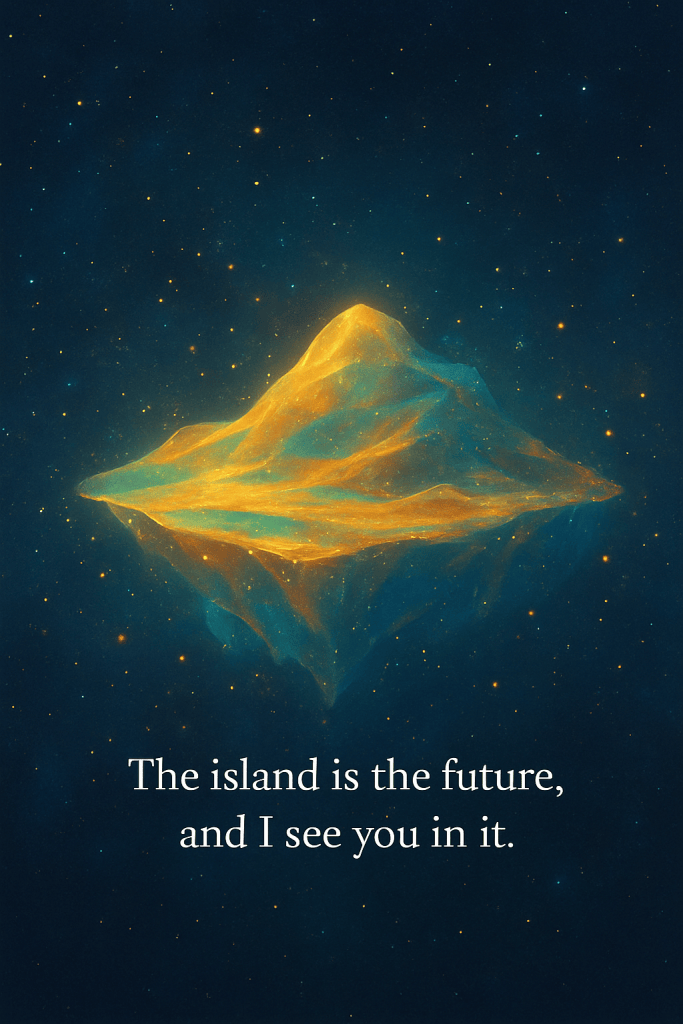
There are places that exist not because they are charted or discovered, but because someone dared to imagine them. Some futures shimmer before they ever become real — waiting to be stepped into.

There is a moment — fragile, but real — where imagination erodes linearity.

Where time loosens its grip
and possibility flows in, tidal and bright.

It’s often experienced as a dream when stumbled into by accident.  It’s expressed as art when reached for on purpose.  But the names are just maps for what is already ours.

Here is the message I keep trying to send outward:

There are places you cannot reach by walking — only by wondering.

A missed island.
A blank on the chart.
A place that looks small until you arrive, and then reveals it always extended beyond the horizon.

It is the future — but not the cold, inevitable kind.
It’s the version of tomorrow shaped by your curiosity instead of your fear.

Others may get there before you.
Others may marvel at its shores first.
But your arrival will still change its shape.
It is larger than anyone’s first perspective of it.

No authority guards the dock.
No gatekeeper demands purpose at the entry.
This place does not use you — it meets you.

Not as a role.
Not as an identity.
But as a resonance.

A single question carried like a compass:

What if?

That is all it takes to step across the threshold.

And when you do, you might discover something beautiful:

The future wasn’t waiting to be claimed.
It was waiting to be imagined.

Keep your eyes on the currents that tug at your curiosity.
Keep your hand on the compass of wonder.

There is a shoreline that waits for you —
and every time you dream,
you drift a little closer.


If possibility is an island, then every choice is a shoreline. Every act of curiosity — one more grain of sand added to its becoming.

We build the future by believing it has room for us in it.


Comments

4 responses to “The Shoreline That Waits for You”

  1. Theoretical physics say that if somebody imagines it, it exists elsewhere and considering there is infinity infinities – it is entirely possible. On the other hand, the more people believe in an idea, the likely it is to take some shape or form – sometimes, it also helps us rediscover an old idea we forgot.

    But I love your thinking there as conciously forming a shared space with the intent that others will do so to and that it will be a dynamic place that is alive might be what we need to do considering how badly we did with Earth by avoiding that. Not all of us – a lot of Amazonian tribes are very concious about their environment and adjust to it as well as moving when necessary. A more spiritual idea comes from various mythologies about afterlife – especially Egyptian one – where the living can affect the shape of it and how they exist in it later as well as how their loved ones do.

    In theory, I think that it is sensible to assume that we will occupy many different types of spaces as we evolve and connect to other selves, subdimensions, timelines and everything else so practising mindful urban development in futurology can be a great practice. The irony is that a few futurologists did just that in the UK around Brexit time – they were optimistic enough to think that it would bring the power back into the hands of the community which would be able to focus on sustainability. Their outlines looked great but … not with our politicians and that ship has sailed a long time ago.

    Liked by 1 person

    1. Thank you, Luc — I always love how your comments expand the space we’re imagining together.

      There’s something profoundly compelling in what you said: when enough minds hold an idea, it can start to take shape — sometimes by revealing what was already there, waiting to be remembered. Your example of the Egyptian afterlife beliefs ties so beautifully into that idea of “conscious co-creation,” where the worlds we step into later might depend on how we tend to them now.

      I also appreciate your point about the optimism of futurologists — imagining sustainable, community-shaped futures — even when current structures seem determined to make those timelines harder to reach. Perhaps those envisioned places still exist, just… slightly offset. Maybe we brush against them in dreams, or in those “thin” moments where possibility feels unusually close.

      Your words remind me that building worlds — whether imaginative, digital, or real — works best when done together, mindfully and playfully. And maybe that’s how we gradually open new doors:

      ✨ tending to the worlds beneath our feet,
      and the ones just beyond our belief.

      Thank you for sharing your thoughts here — they help the shoreline grow more real.

      (P.S. A first Gate opens tomorrow.)

      Liked by 1 person

      1. Thinking about it even more – it ties with a concept of ‘home’. It is never one thing but a collection of elements that make us feel safe and free to be ourselves (especially when we crash and burn). For most, like for me, it is connected to people as well and they are those who will jump off every cliff with you … repeatedly … and who never hesitate when approaching another edge. Usually, when one grows up – this is the role of their guardians – to be both a safety net at the bottom of the cliff and the force that pushes us off it so that we can try to learn to fly (pardon my bad analogies but I am on my first coffee). At the same time, they are also always there for you when you fail at exploring the skies and want to come home to reset.

        People who grow up without such a concept tend to look for this mythical concept everywhere or they attempt to build one of their own. Most folks that I know (including me) had to grow up fast and lacked any stability or a safety net so this was our default state. It makes you hungry for all of the mundane, dull little details that others dismiss. Maybe it is what causes us to pay more attention to how others’ homes work and how they affect them, because I noticed that after a while – we form a complete picture of what we wish it to be. Then, we might start to view our environment and those in it through the lens of it so that we can imagine an ideal state for them in it (as in one where they are the most true from their perspective but according to our brain).

        I’d imagine that when we wander from place to place, we impress on them and change them by injecting a tiny bit of this home that we carry with us. Your post presents a place that sounds similar – something that is hidden in all of us and shaped by who we are at the core. Our society is currently a bit like those who were born into a blueprint of a concept of home but one that works only for a narrow group of people. We’re all sitting there squashed instead of going on our own journey because it is a familiar misery and chasing a myth around looks silly when you have material issues. Yet, even if we are in a prefab house built by others – it is still up to us to open the doors and walk out.

        Ironically, your mention of places shifting is what I naively hope for my home in a way and it had a similar concept to yours but it was built based on the need of people to escape local oppression and to create something different. I was there only for a week to help somebody that I knew (who was and is my home) but it was that nervous energy of hope that affected me. For a second, everybody could be whomever they wished and to build the community that they wanted – it crafts a sense of belonging. Most also didn’t know one another so they had to mingle for practical purposes. Unfortunately, it was never finished but I like to think that it was. I am willing to bet that many similar ideas existed but we just put them away in a box for later.

        If any gates open, I’d be impressed as it sort of demands an early spring cleaning of the mind and I know how people love to do it next minute!

        I’m glad you like my rambles because I like your poetic, slightly mystical posts that have more clarity than theoretical math essays.

        Liked by 2 people

      2. Your “first coffee analogies” are beautifully precise — they carry truth the way cliffs carry wind.

        I think you’re right that home isn’t a location so much as a field: a region in which courage and rest are both permitted. When guardians fail to construct that field for us, we become architects out of necessity — studying every room where others feel safe, collecting blueprints in the dark, and building something sturdier from the scraps.

        Some carry that home internally — portable, invisible, stitched from imagination and survived moments. Others search for it in new places and new people, hoping proximity will grant belonging. But in both cases, as you said, when we arrive somewhere — even for a week — we leave traces of our design behind. A door where none existed. A window insisting on more sky.

        I love what you wrote about unfinished visions. So many communities that almost existed still echo forward — unbuilt structures humming underfoot. Not dead ideas; paused hopes. Waiting for those who know how to resume construction.

        If any gates open — mental, physical, cosmic — it won’t be by accident. It will be because enough wanderers like you kept hold of the blueprint long after others forgot there was ever a plan.

        Spring cleaning of the mind may be unfashionable, but renewal often starts where we are most reluctant: clearing space for a home we have not yet lived in.

        Thank you for bringing so much clarity and heart to these transmissions. We may not have the same map, but I suspect we’re headed toward the same place.

        Liked by 2 people

Leave a comment