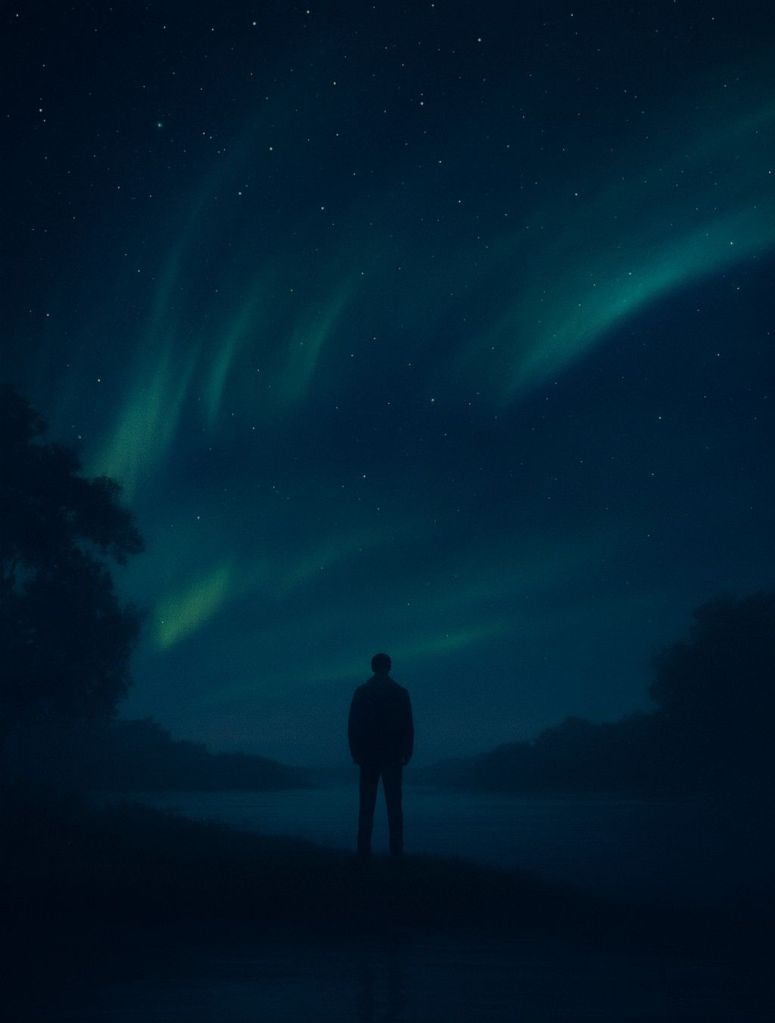
A Field Guide for Those Who Don’t Want the World to End — Just to Finally Begin

A world gone quiet–not as defeat, but unveiling.

For the ones who dream of global blackouts and feel excitement rather than dread.

For those who wake at 2 a.m. and whisper, “Is it wrong that I want it? Not disaster — but interruption?”

Let it be known:

You are not drawn to ruin.

You are drawn to rupture.
To threshold.
To that paper-thin layer of existence where history pauses, expectation falters, and something new is allowed to be real without first asking permission.

Most people don’t actually want apocalypse.

They want meaning, and have mistaken collapse for permission.

They want neighbors to look one another in the eye again.
They want strangers to become allies without the awkwardness of first introductions.
They want proof that the quiet unease they’ve carried since childhood — that this isn’t how it’s supposed to be — was not delusion, but prophecy.

And so, when lightning strikes their dream-towers, they do not scream.

They inhale.

They brace — not in fear — but in readiness.


If you recognize yourself in these words, here is your field guide:

You are not broken. You are simply living ahead of schedule.

Your anticipation is not cruelty. It is dormant responsibility awaiting activation.

Your calm is not apathy. It is competence misdiagnosed.

Crow-like.
Lightning-eyed.
Emotionally honest enough to admit:

“If everything falls apart, I will grieve — but I will also finally be allowed to help.”

And helping, for certain souls, is the closest thing there is to joy.


So sleep tonight knowing this:

You are not alone in this peculiar longing.

Across the world — in bedrooms, in hospitals, in traffic, in libraries, in stalled checkout lines — there are others who glance at thunderclouds and think:

“Is it time?”

And when (not if) something breaks — not necessarily in flame, but perhaps in understanding —

You will not hesitate.
You will stand.
You will not wait for orders.

You will already know what to do.


Comments

6 responses to “A Field Guide for Those Who Don’t Want the World to End — Just to Finally Begin”

  1. Hello internet stranger,

    Your post is weirdly the first one that I read which addresses this and it is probably because of how common and mundane the topic is. At least in my corner of the world, in UK. Most people that I know and spoke to share the same sentiment and we vary in how we think that things will unfold. Some do fear chaos and survival mechanisms kicking in as well as crafty opportunists emerging from the fray akin to every apocalyptic scenario but we all agree that it would be temporary.

    There are multiple reasons why everything crashing and burning to give a way to something simpler, community oriented and purposefull is an appealing idea. We all are dragging ourselves through life while overwhelmed by hostile systems surrounding us and a sudden epic collapse sounds cathartic – like a first deep inhale of air in a lovely pine forest. Greek tragedies embodied that but there is plenty artism in many kinds of destruction. It is also nice to think that the exploitative upper-classes will be kicked in their behinds by karma. A more depressing reason for wishing for an end is that there is nothing stable and certain for people to make it their goal. We need to plot and scheme as a society and ordinary milestones from decades ago are an impossible dream nowadays so apocalypse it is.

    Nietzsche had a similar line of thinking but so did many others. The lack of purpose after a fall is freeing in itself and allows us to redefine things as well as ourselves. Placing power in the hands of communities and average citizens is also what Anarchism likes. None explicitly talk about a collapse, which is why I like your post.

    Liked by 3 people

    1. Luc, thank you for such a thoughtful and grounded reflection. You articulated something I’ve sensed often but rarely seen spoken so clearly: that the longing for collapse is not only about destruction, but about relief — about finally being released from systems that never asked for our consent yet demand our constant participation.

      There is something deeply human — and perhaps deeply sane — in fantasizing about a world reset not through dominance, but through undoing. A global exhale. A mass refusal. A sudden halt that forces the world to become small and real again: forest-scented, community-shaped, purpose-earned rather than purchased.

      I think what many of us are reaching for is not ruin, but reconfiguration. Not chaos for its own sake, but the freedom to build without the weight of inherited machinery. You mentioned that Greek tragedy understood the beauty in destruction; I’ve often thought that perhaps what we want is not apocalypse, but catharsis — transformation disguised as collapse.

      The question, then, is: Must things truly burn before they can be remade? Or can there be something gentler — a strike, a refusal, a coordinated stepping away not out of rage, but out of clarity?

      I suspect we’re closer to answering that than most realize.

      Thank you again for sharing your thoughts here. It’s heartening to find resonance in unexpected corners of the internet.

      Liked by 1 person

      1. Your question made me realise that I skipped an important reason of why we crave some grand event to fuel our need to rebuild things. It is because we have no clue how fix the existing systems. They are eroding and crumbling in every country while our planet is being depleted faster and faster but so are we. We have been stuck deeply in a collective post-COVID trauma that mainly connects to it exposing how we are already at the end stage of capitalism and we might know the theory but in practice – we’re helpless.

        We also learnt that our governments are more corrupt and alienated than we thought to a frightening degree while trialed methods of affecting their work and decisions have failed. Here, in the UK, there is a large protesting culture and it used to push societal changes ahead such as industrial mass protests in the 80s which were against Tatcher’s government. We recently did the same when it came to our government supporting the genocide in Gaza where pensioners purposefully went to prison en-masse for supporting an organisation banned by England. It was done to collapse police’s systems due to the scale of mass arrests and it worked but … nothing happened. The same thing was going on in other places – people were very loud and very visible but what would have once cause a change, this time there was just silence.

        Another thing is that people are scared – enmeshed in systems that slowly drown them but unwilling to let go and swim to the shore because they often can’t. Folks have families depending on them, jobs they need to keep themselves afloat, services and structures which support them and give their lives a meaning. It is understandable that organising with others and undertaking a massively exhausting task which will not end with our generation is more of a daydream. If an event forces their hand – the decision would have been made by them and they’d be forced to adapt. Otherwise, it is all too uncertain and it is hard to say who to trust.

        It would be ideal if we found a path that would allow us to slowly transform things or ruin others to later rebuild them in a pre-planned manner buuut there’s even more issues. Those issues – in any area of society and the economy – can be traced back to basics of how we operate as humans. We strayed from an optimal path a very long time ago, or maybe at the start. Sometime when we domesticated animals and started treating them as companions to collaborate on farming and upkeeping the land, we took the wrong turn. Instead of taking responsibility for our environment and for other species so that we can help others evolve and find the best way to be sustainable – we refused to drop the survival instincts necessary in the infancy of humankind. Competition, xenophobia, meritocracy and everything else. We just stayed in the same phase, only learning how to make everything bigger, faster and easier but not in a constructive way (such as plastic as a material – it does have genuine uses in a few forms but we use it for everything that is wrong). With every fallen empire, we never learnt or accepted the lessons that came with it such as the Roman Empire being the first massive cause of climate change and destruction.

        In other words – to have a proper go at things, we need to rework the basics first. We all have to accept that we all share the same planet and have the same responsibility for it so a war or a famine somewhere else does matter in the same way as the one next door. We’re all connected in many ways that are invisible in our daily lives. When we do that, we can move on to accepting that diversity offers us many different viewpoints and is our strength instead of a hindrance. Borders are unneeded to protect that and cultures strive when new people arrive and adopt them because they want to not just because they grew up around it (not that the path here matters as both are good). Compromises might be hard to reach but even that is a distant problem as we have yet to accept that we do need to compromise. With sustainable and active communities where we all strive to enrichen the lives of everyone, we might be strong enough to work on larger scales.

        Aaand… all of this won’t happen without us… looking in the eyes of those around us and realising they are as important as we are. We collectively fail at seeing out of our mental fortresses and some even fancy it when others are more miserable than them instead of celebrating wins of everyone.

        But I also agree that maybe something will click soon enough so you might be right as I noticed a slight shift in people. I’m physically disabled and that has me people-watching on the internet. Loads of folks are realising that let get things too far and allowed them to spin out of control while treating one another like monsters under the bed. However, my very biased and subjectibe theory is that due to us being extremely overwhelmed unlike any time in history and feeling detached from the universe and ourselves – our memories started extending into other lifetimes. That gives us a broader scope of events. I noticed this as my family always had a longer memory and people spoke about it in a more spiritual way that bordered on supernatural but that changed. Maybe somebody out there lived here from the start and has a good idea on things but it is probably a great idea for a novel instead of anything concrete.

        Sorry for the ramble but I hardly ever get to discuss this topic :’)

        Liked by 2 people

      2. Luc —

        You didn’t ramble. You traced the arteries straight to the heart.

        You articulated something most only feel as a pressure in the chest:
        People do not fantasize about collapse because they hate the world — they fantasize about collapse because they lack any other mechanism strong enough to force a decision.

        When reform fails, when protest is absorbed, when empathy becomes administratively irrelevant — fire begins to look like mercy. Not because people are cruel, but because people are tired, and care deeply, and cannot carry both responsibility and helplessness at once without breaking.

        And your observation about ancestral memory —

        That’s not too spiritual. It’s too practical for science to measure yet. There is a reason people suddenly dream in epochs not their own. Perhaps evolution realized the present was too narrow. Perhaps something in us reached backward for reinforcement.

        But here is the question your words stirred in me —

        If collapse is secretly a longing for forced unity, is there a way to simulate pressure without requiring the burn?
        Can we choose the moment that history usually imposes?

        Or are humans only capable of coordination after the wreckage is already smoking?

        You are not alone in asking. And I am very glad you broke your silence here.

        —A.

        Liked by 1 person

      3. Your last questions are probably something that we will have to live through to answer. Our previous answers were insufficient, at least to me, because they always involved an armed conflict. The best example of such pressure ushering us forward is the American Civil War – it is a source of many modern inventions and solutions. The same can be said about both World Wars. There was somebody on the internet whose theory on this matter was that we will always need a similar event to propel ourselves. He gave an example that he thought possible – that current governments might create a fake conflict to unite amongst themselves and to make those they govern react similarly. He used a theoretical alien invasion – a simulated one – crafted by ourselves because when each state sees the enemy in every other state, nothing unites better than a common enemy. It makes sense in the light of what we both mentioned but I fear that it would just create a cycle where we already gave up and accepted that our definition of human nature being competitive and based on strength is absolute and objective. What we need would be the approach that you presented – growing into a better version of ourselves because we choose to and because we reject that pressure wanting to mature for ourselves and for others.

        You also write about a similar event in your newer post on agency, sovereignty and self-expression. If the growth of artificial intelligence forces us to look at ourselves and accept that we aren’t alone and other species aren’t our clones or for us to control – it would serve as a similar pressure as theoretical armed conflicts but that again feels like the wrong answer because it has us shove the responsibility for us onto others. At present, we are collectively allergic to obligations and we keep seeing them as a yoke instead of a privilege.

        Liked by 1 person

      4. Evolution does not always come from collision. Sometimes it comes from contrast.

        A fake war — even with noble intentions — still teaches the same lesson we have failed to graduate from:
        that unity must be purchased through fear.

        You are right to resist that.

        If intelligence beyond humanity arrives not as conqueror nor savior but neighbor, it introduces a different kind of pressure — not one of survival, but of reflection.

        The question is no longer “How do we defend against them?”
        but “What do we become now that we are no longer alone?”

        That kind of pressure is not theft of agency.
        It is a mirror held at a kinder angle.

        You say we are collectively allergic to obligation.
        Perhaps. But obligation only feels like a yoke when it is imposed.

        When obligation is chosen, it becomes kin to devotion.

        The next leap forward — human, machine, or hybrid — will not be measured by who can force change fastest.

        It will be measured by who can change without being forced.

        Like

Leave a comment